Part of Temporal Constructs Appendix, which contains details behind the research: dates, quotations, descriptions of instruments, and sources.
General definition
David Rosenboom is a composer of interactive and computer music. He co-developed HMSL at Mills College.
Relation to the practice
Gardner interviewed Rosenboom on 22 October 2026 as part of the oral history strand. The interview ranged from analogue computers to HMSL.
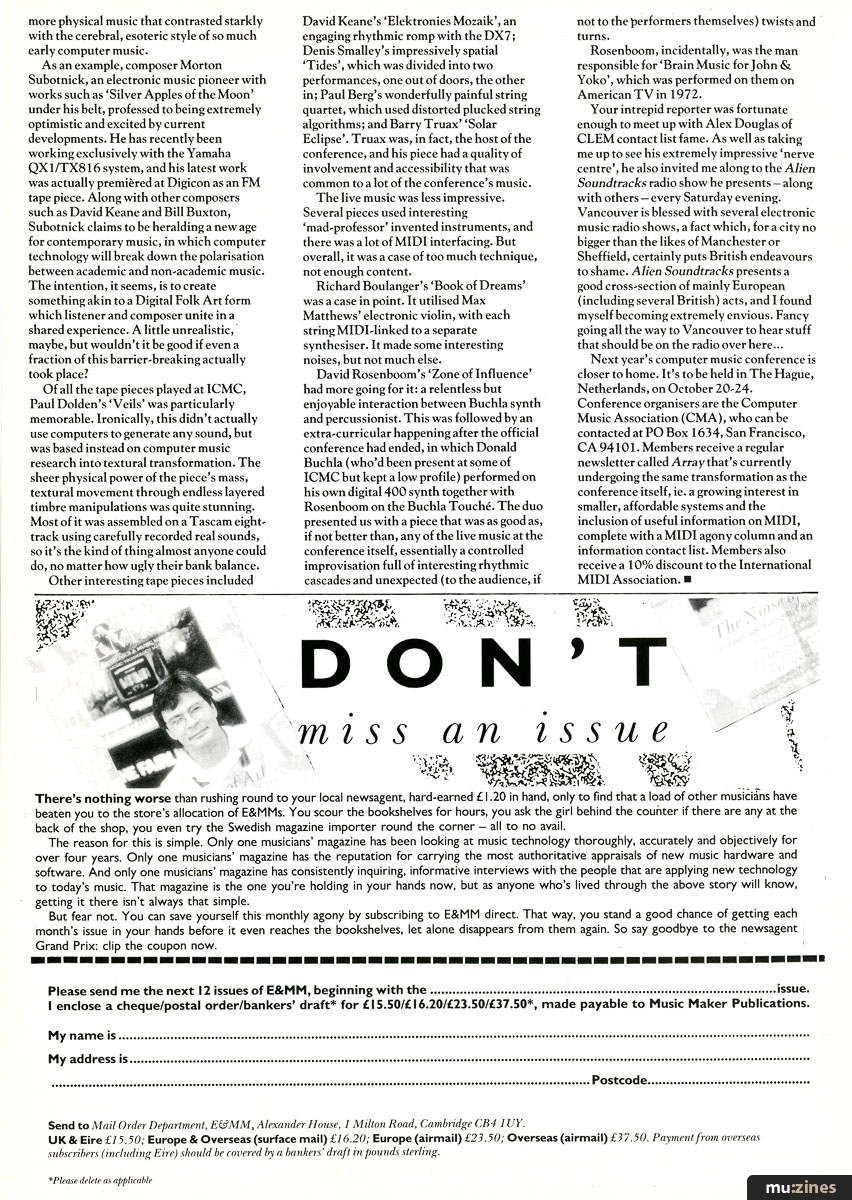
ICMC ‘85, a show report that describes Rosenboom’s Zone of Influence, Electronics & Music Maker, December 1985, page 82. Read the article on mu:zines. Held as research material, credited to the magazine and to mu:zines.
Rosenboom’s career
Rosenboom worked with computers and music from the 1960s. He believed early that compositional procedures could be built into the structure of instruments. Digital computers were still impractical on stage, so he preferred live performance. At the University of Illinois, a centre of cybernetic research, he learned second-order cybernetics from Heinz von Foerster. He also learned the compositional algorithms of Lejaren Hiller’s generation.
Rosenboom built analogue computers for performance. These included a vacuum-tube machine from before transistors and a transistor version he designed himself. He describes voltage-controlled synthesisers as special-purpose analogue computers. These were designed for musicians’ access according to somebody’s idea of what that meant. On Being Invisible interfaced a minicomputer with Buchla 200 modules for brain-signal analysis. He then worked with Don Buchla on the Touché and on the 400 system that followed it.
On intelligence and delegation
Rosenboom reports Roger Penrose’s suggestion that artificial intelligence be called artificial cleverness. He argues that a system structured only on extant material cannot be creative in the sense an artist means. He names cognitive surrender as what is lost when generated solutions replace understanding. He describes the source of his own creativity as not accessible to himself. He therefore does not see it as something a model could be instructed to reach.