Part of Temporal Constructs Appendix, which contains details behind the research: dates, quotations, descriptions of instruments, and sources.
General definition
A saved snapshot of settings, from a single parameter to a whole composition, that lets an earlier decision be recalled instead of made again.
Relation to the practice
A decision built into the instrument is Akrich’s de-scription (1992) and Latour’s prescription (1996). The preset is the everyday name for what the two of them describe.
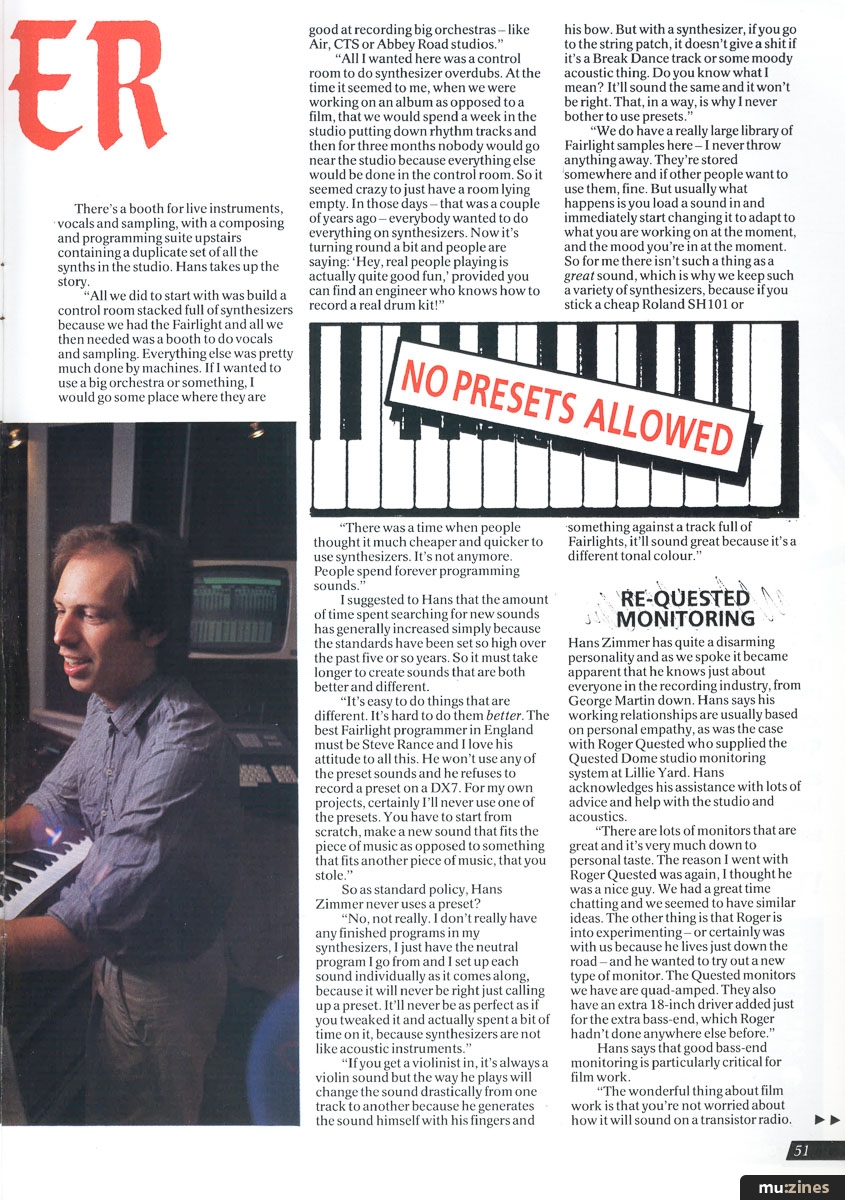
No Presets Allowed, an interview with Hans Zimmer on refusing factory presets, Sound On Sound, August 1986, page 53. Read the article on mu:zines. Held as research material, credited to the magazine and to mu:zines.
In CONDUCTOR, presets are stored in each module’s snapshot memory and recalled by program change. A decision that need not be thought through twice also becomes a constraint, and therefore an affordance. Factory presets are a form of embedded authorship, and in the sense of expert systems they work as heuristics. Drew Schlesinger is the practice’s best-documented case. He has made factory presets for over two hundred instruments since 1984 as an independent designer working through Synthetic Productions. Together the presets form a possibility map of their own. Recalling one preset replaces re-executing an idea, so creative intent is spread across an open-ended and growing catalogue of stored decisions.
Creative intelligence is embedded and becomes distributed between the creator of the preset, the nature of the synth, and the performer.
artist statement
Unforeseen
Here the unforeseen situations, sometimes difficult, sometimes unexpectedly interesting, will be described as the project runs. Many of these unforeseen situations have already occurred and have been recorded. They will be added in the time to come.