Part of Temporal Constructs Appendix, which contains details behind the research: dates, quotations, descriptions of instruments, and sources.
General definition
A sequence with a start and an end that connects presets into one motion or gesture. It lets what happens when be planned.
Relation to the practice
Suchman (1987) is the account of the gap between the plan and what is actually done. Roads (2015) describes the sequencer as recorded events that can be replayed. The timeline is where the two meet.
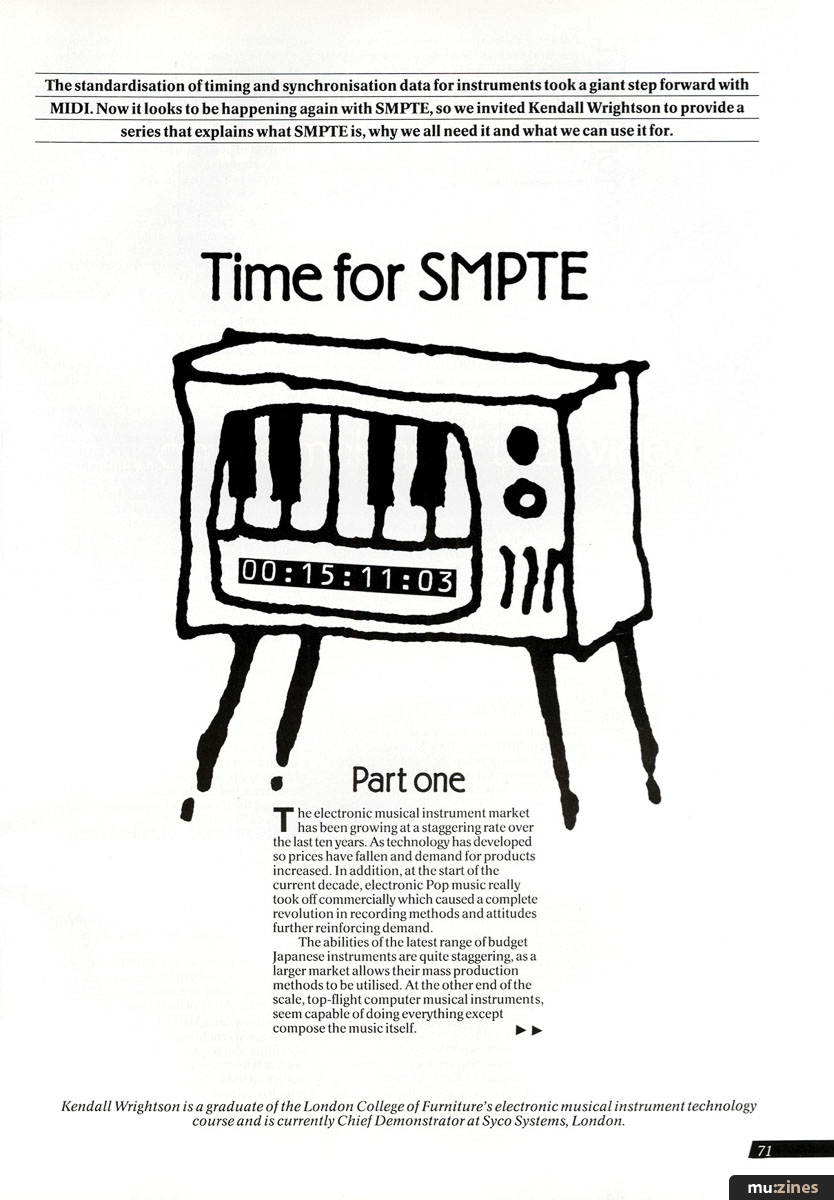
Time For SMPTE, the first part of a series on synchronisation, Sound On Sound, November 1985, page 73. Read the article on mu:zines. Held as research material, credited to the magazine and to mu:zines.
CONDUCTOR has one timeline with sixteen tracks, one per module, modelled on the sixteen MIDI channels. The timeline recalls snapshots at the right moments, and it can be started and stopped from the command language. It can also follow external timecode, and presets are its material, so the timeline cannot be defined without them. The sequencing knowledge is built into its structure, and a result can be reasoned about before it is produced. That makes change over time a designed object, and not a series of separate actions.
The tense test keeps the timeline apart from presets and context. The timeline describes what will happen, a preset what was decided, and context what has been encountered and still shapes what happens now.
Unforeseen
Here the unforeseen situations, sometimes difficult, sometimes unexpectedly interesting, will be described as the project runs. Many of these unforeseen situations have already occurred and have been recorded. They will be added in the time to come.