Part of Temporal Constructs Main Text, which states the research questions, the proposals, the work done and what is still open.
General definition
A visual programming environment for interactive composition, which Miller Puckette created at IRCAM in the mid-1980s and named after the computer music pioneer Max Mathews. Philippe Manoury’s Jupiter of 1987 first used it to synchronise a computer to live instruments. Opcode brought it to commercial release through David Zicarelli, who had also developed M.
Relation to the practice
Max makes the system one instrument. It connects the composition to sound, visuals and lighting and keeps the state of a performance in memory. It routes signals between every component and generates the unpredictability that keeps the machine’s behaviour from settling. A version confined to MIDI is enough for all of it, which is the point the research makes about protocols.
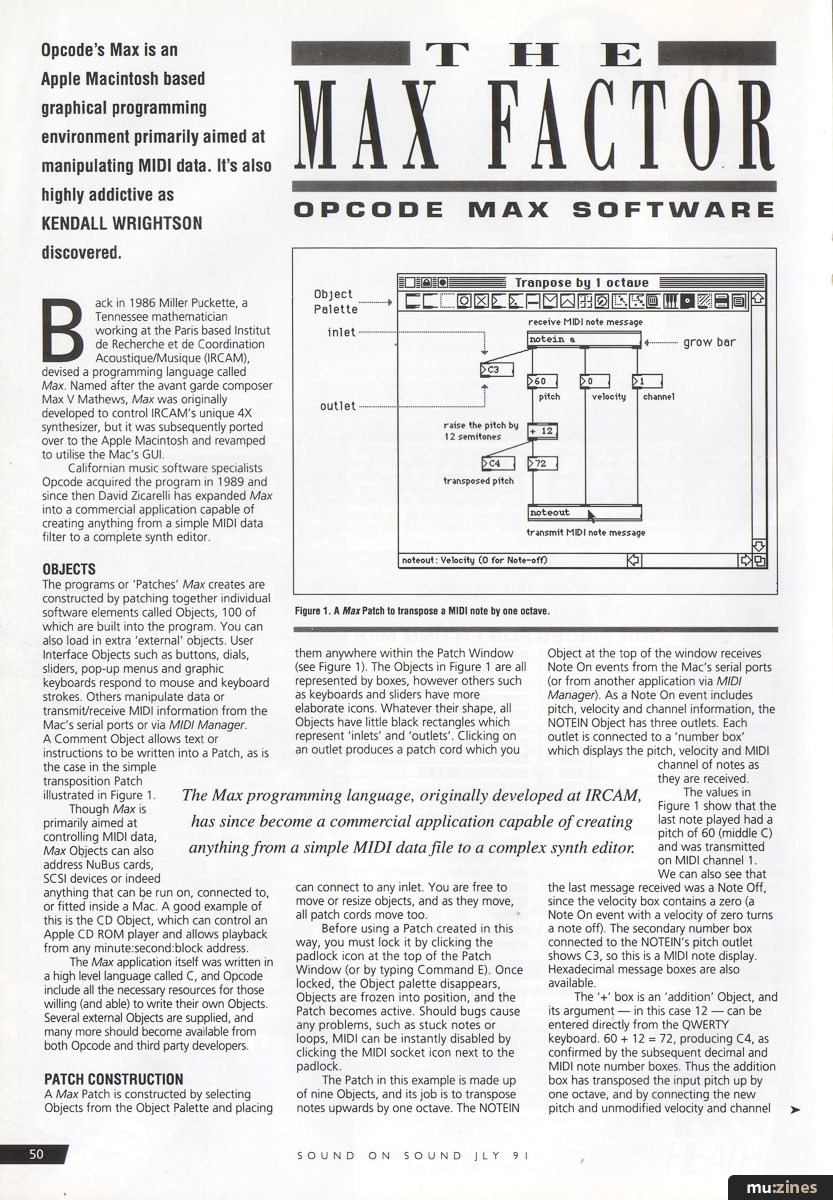
The Max Factor, a review of Opcode’s Max, Sound On Sound, July 1991, page 52. Read the article on mu:zines. Held as research material, credited to the magazine and to mu:zines.
A small and stable vocabulary does this work when the instruments at both ends are built to be legible. The work’s narration describes Max as the program that turns the process of programming into a visual interactive form of play. A system whose construction can be watched while it runs is one a person can learn and correct (Shared language and transparency).
The devices of CONDUCTOR are prototyped here, by hand, in a run of quick interactive changes that continues until the component is finished. That work is described as the part of the practice reserved for humans, and it is why the environment for it is a visual one.
First orchestration
At the premiere of ALTERITY in January 2026, Max 2.0 was the orchestrator. It ran on the SE/30, with an Emagic AMT8 interface passing the MIDI between the machines. Its own objects did what the framework later gives to devices and snapshots. The preset objects stored a whole state in memory, and the line objects carried temporal effects.
Those temporal effects made parameter movements change gradually over time. The timeline sat outside the machine and sent recalls into it. The hardware around Max was close to what the later versions ran, so the framework replaced the orchestrator. It did not replace the instruments.
Unforeseen
Here the unforeseen situations, sometimes difficult, sometimes unexpectedly interesting, will be described as the project runs. Many of these unforeseen situations have already occurred and have been recorded. They will be added in the time to come.