Part of Temporal Constructs Main Text, which states the research questions, the proposals, the work done and what is still open.
General definition
M is an interactive composing and performing system, released by Intelligent Music in 1987 for the Macintosh and later for the Atari ST, the Amiga and the PC. The performer gives it notes and chords and sets how they are transformed, so the program composes with that material while the music plays. It holds four voices. Its makers described it as an intelligent instrument, and the authors named in its manual are David Zicarelli, John Offenhartz, Antony Widoff and Joel Chadabe.
Relation to the practice
Gardner worked with probability-based sequencers before it, among them the Elektron Octatrack and the Squarp Pyramid. M moved him from using technology as a tool to working with it as a creative partner. It runs on the Macintosh SE in ALTERITY, it was used for the Metius EP Computered Visions, and agents have operated it directly. Its interface keeps its processes visible, which is the principle of human involvement, and one of its authors, David Zicarelli, is the work-field supervisor of the doctorate.
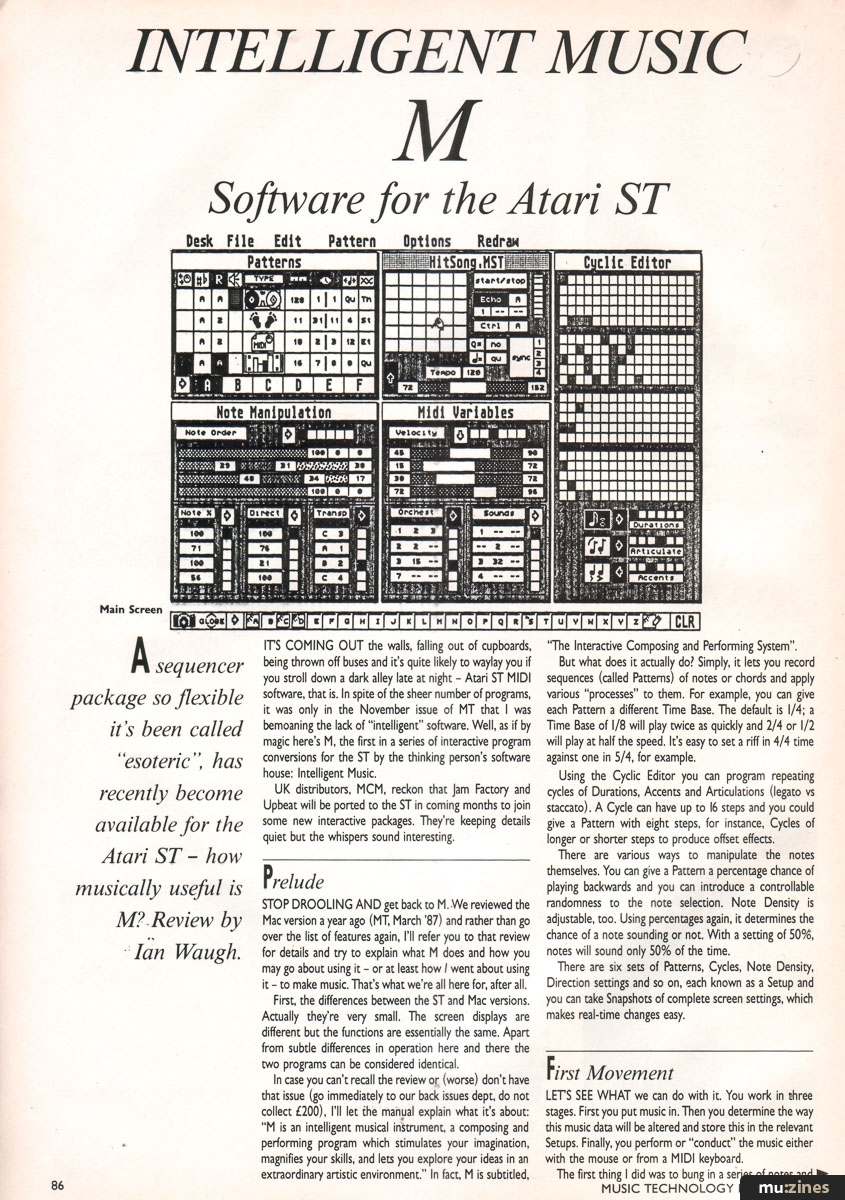
Intelligent Music M, a review of the Atari ST version by Ian Waugh, Music Technology, March 1988, page 88. Read the article on mu:zines. Held as research material, credited to the magazine and to mu:zines.
How it works
M holds four independent patterns, and the performer fills them with notes, chords and rhythms. Each pattern can be sent to any combination of MIDI channels, so one instrument can carry all four voices at once or each voice can go to a machine of its own. From there the material is shaped by variables: the order the notes are played in, the density of the notes, their velocities, their lengths and their accents. The player sets those variables and the program applies them while the music runs.
The program makes no sound of its own. It sends instructions to the synthesisers, samplers and sound modules that do, which is why it can be described as the player of the instruments rather than as an instrument itself. In ALTERITY it drives a Kurzweil K2000; in the masterclass recorded as In Conversation with Your Instrument it drove a Roland S-330.
Its makers described it as an intelligent instrument, and what they meant is visible in the working method. The performer supplies the musical material and the program transforms it, so the material is never simply played back. Its author compared the program to the cockpit of an aeroplane: many controls, all of them in view, all of them held while the music runs. Joel Chadabe had coined the term interactive composing in 1981 for instruments that share the control of the music with the performer, and M is the program that carried the idea into software.
Composing and performing at once
The program’s own account of itself, quoted in the Sound On Sound review of 1988, is that it “becomes part of the actual process of composition”, and that its controls let a performer work so quickly and interactively “that the line between composing and performing becomes blurred”. The practice reads that blur as improvisation: the material is given in advance, and what happens to it is decided while it is heard.
The means are the controls. A performer can conduct any variable by moving the mouse in the conducting grid, play from a MIDI keyboard, work the screen controls directly or step through stored positions. A snapshot holds the whole state of the screen at one moment, and a sequence of snapshots can be run over a performance as a slideshow. Because the program holds four voices, the same gestures can change all of them at once or one of them alone.
Conducting itself
The program can also conduct without a hand on the mouse. Automatic Conducting, which the manual calls the Robot Conductor, walks the baton around the conducting grid by itself. The performer sets how far it travels on each axis and how often it jumps, and can leave it running while playing another instrument or singing. The manual adds that the player may keep conducting while it runs, “if you like the idea of being second-guessed all the time”.
That is the property the practice takes from M. Control is shared rather than handed over: the program decides within a range the performer sets, and the performer can take the decision back at any moment. The material is ordered by randomness as well as by rule, so what comes back is not what was put in. It is the behaviour the practice describes in the Intelligent instruments of the MIDI era as what their authors could not fully predict.
The interface
M is designed so that nothing about its operation is hidden. Its main screen is a control panel that shows the program’s operations at once, in six divisions: the patterns, the conducting grid, the variables, the cyclic variables, the slideshow and the MIDI routing. The windows stay live while the music plays, so any control can be reached at any moment, and the effect of a change is heard as it is made.
What the program does is therefore visible while it happens. The mouse pointer becomes a conductor’s baton when the conducting window is used, and when the program conducts itself the baton keeps moving in the same way, so its decisions appear as the movements a person would have made. The decisions are the program’s own, and they are shown rather than hidden. That is why the interface kept the performer cognitively present, and why the practice’s own interface design is inspired by it.
Operation by agents
The doctorate has operated M through the same interface its performer uses. In the demonstration of In Conversation with Your Instrument the program was driven by the voice rather than the keyboard: one model transcribed speech and a second judged whether the input was a human voice or not. The same control system was later given to the agents, which let them operate M directly. The record of results counts that as an agent-initiated use of the instrument, and the relation was described in September 2026 as a triangle of the person, a language model and the sequencer M.
M has also been demonstrated in public: in the masterclass recorded as In Conversation with Your Instrument, and in the presentation of the research at AI in Muziek 2026.
The works
M ran on a Macintosh SE of 1987 in ALTERITY, where the narration says that the notes the audience hears are the program’s, and describes the two Macintosh computers as something like a brain. M is the creative half of that pair, and Max is the half that receives M’s playing and translates this to a variety of other machines.
Its four voices are also how the practice places sound in a room. In In Conversation with Your Instrument they were mapped to four speakers for quadraphonic sound, one voice to each corner, which connects the program to the quadraphonic work the practice had studied before the doctorate began. By representing each of M’s voices spatially, an audience becomes uniquely involved in the decisions made by M.
The Atari ST version was used during the audiovisual improvisation of the same name at the Amsterdam Dance Event in 2020, where Trip-A-Tron supplied the visual material, M the musical material and a Roland sampler the sound. The program was used for the Metius EP Computered Visions, which holds four improvisations with it, each working a different aspect of the program, and it appears in Overmacht who also use M in quadraphonic configurations.
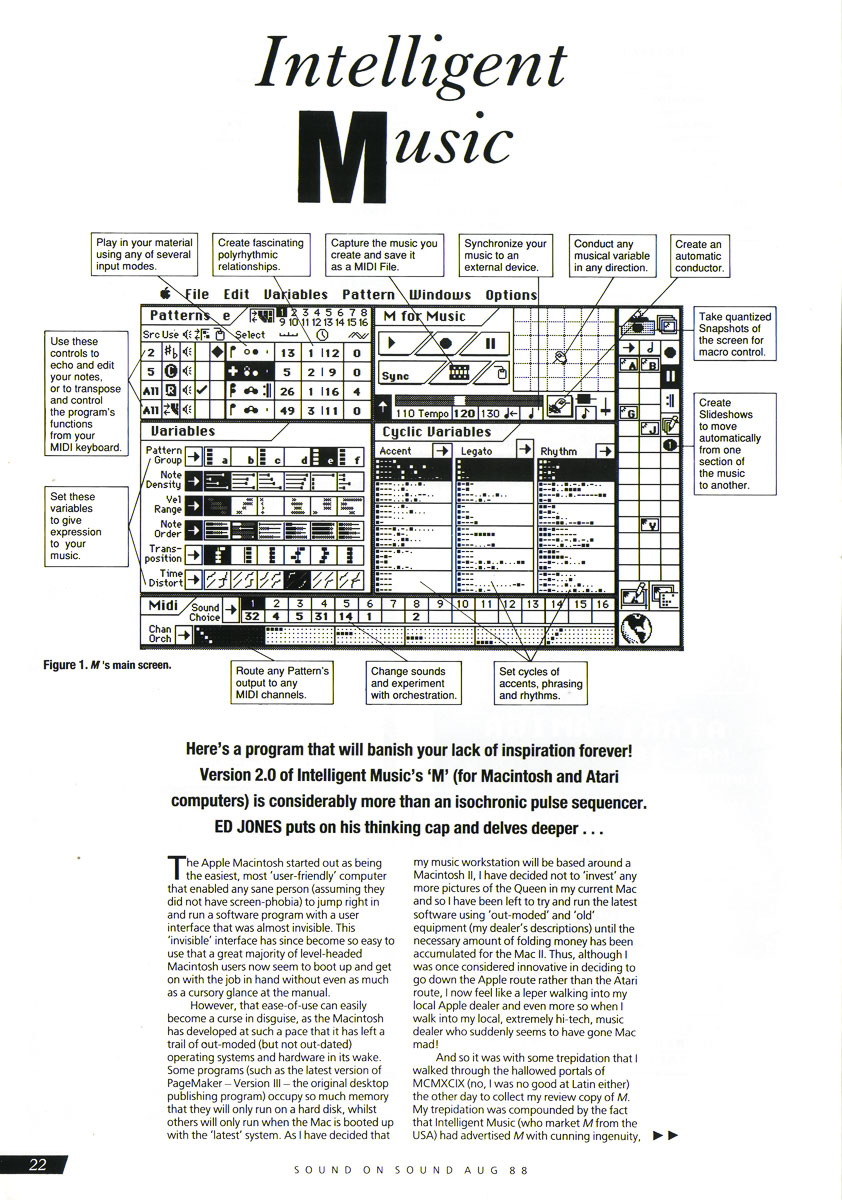
Sound On Sound 1988
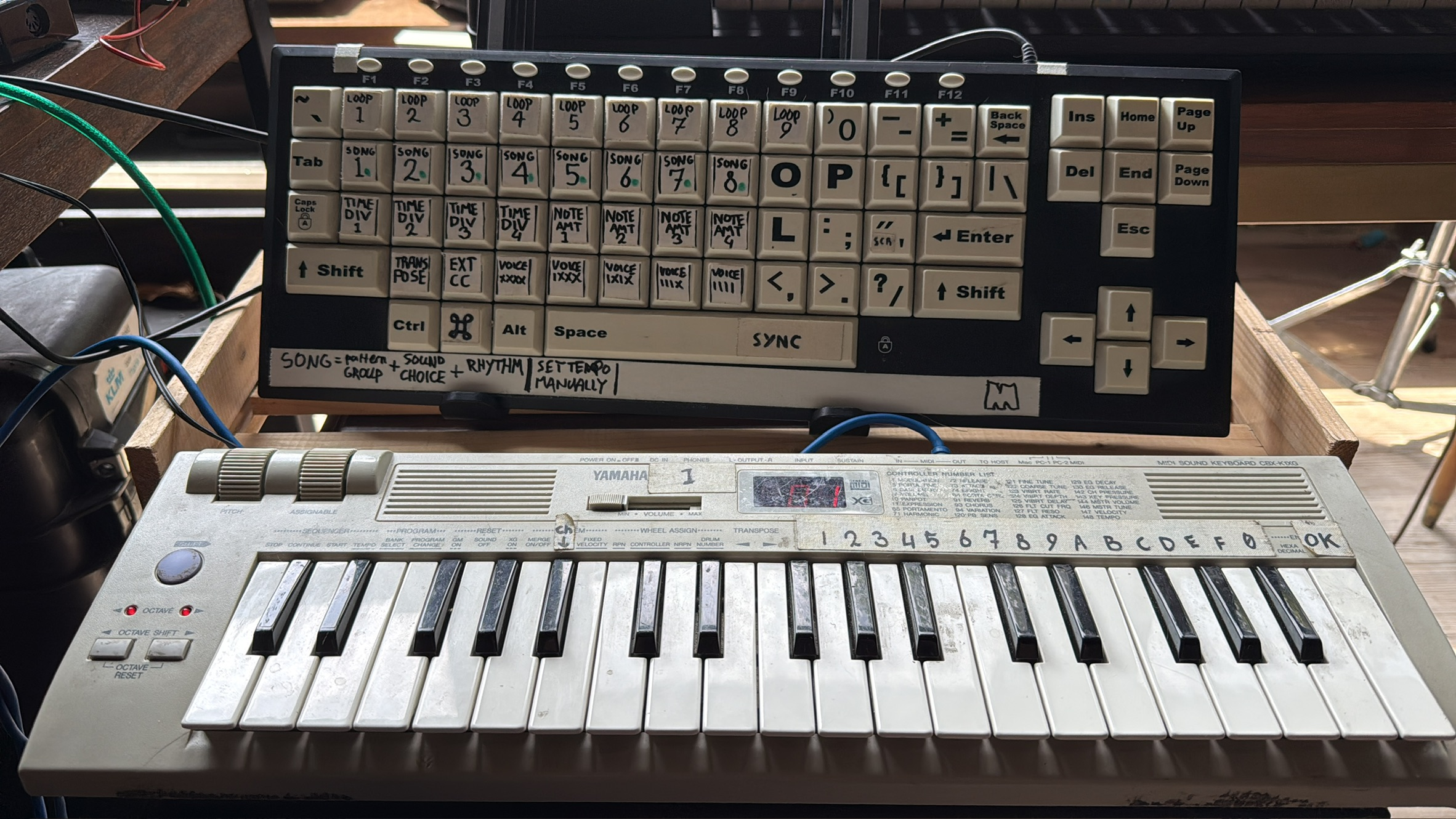
Custom M control surface using the Input Control System which came built into M (ICS)
Intelligent Computer Music Systems
M was published by Intelligent Computer Music Systems, which traded as Intelligent Music. Joel Chadabe founded it to build an interactive instrument for musicians rather than a machine that plays back what it is given, and the company was small enough that the program carried its argument. Chadabe’s account in Electric Sound (1997) records the aim and the difficulty: the idea was ahead of its time, and the company had vision and little capital. The practice treats the company as the historical case it argues from, where the instrument was designed to share control with its player at a time when the technology could only just carry the idea.
Some recordings made with M and the Kurzweil K2000, composed for a video series highlighting other PD candidates.
More recordings can be found on the K2000 page.
Reception
M was received as something new. The review in Music Technology of March 1987 opens by calling it “totally without precedent”, and its verdict is that M and Jam Factory moved the MIDI revolution forward by leaps and bounds, adding that neither program creates good music by itself, because each manipulates only the material its player provides. The review in Sound On Sound of August 1988 calls version 2.0 considerably more than a pulse sequencer, and it is more sceptical of the makers’ language, noting that the program had been advertised without revealing much about it.
Both reviews record the same two properties the practice works with. The first is the visibility of the interface: Music Technology writes that it gives simultaneous access to every control, which matters because so many of the controls are used while the program plays, and Sound On Sound writes that everything needed to run the program is in front of the player on one screen. The second is the program’s reach when it is set up well. Music Technology calls the possibilities mind-boggling, and Sound On Sound records the Automatic Conductor that randomises the variables further, together with the manual’s own advice not to use all of the program’s features at once. With the right amount of preparation, M could sound surprisingly human-like even when running fully autonomous without human input.
The record
Two later accounts of the program are held here. A feature by Tim Conrardy in MyAtari, published in January 2002, records the ports this doctorate depends on: the first version was written for the Macintosh, and versions followed for the Atari ST, written by Eric Ameres, for the Amiga, written by Darien Fitzgerald, and for the PC, developed by Voyetra as M/pc. The article describes the Atari ST version screen by screen, and it records the release of that version as freeware.
An article by Peter Kirn on Create Digital Music, published on 22 June 2007, records the release of M 2.7 for the Intel Macintosh with Core MIDI support. It names the four authors and shows the software being maintained twenty years after its release, which is the continuity this practice works with. The 1987 manual for the Atari ST version records the program’s own working method, and the manual for M 2.7 records its interface.
Before M, I had tried the Interactive Phase Synthesizer which is part of MIDI Cubase. That was the first of the Intelligent instruments I tried and it wasn’t ideal for live performance, though very interesting for studio experimentation. M was the first time I found a software midi instrument so focused on live performance, while equally focused on composition. It closed a gap I had not been able to close during my career as a performer, and I was hooked on it ever since. It was intimidating for a while, and it took time to find the right balance between programming and live-interaction. I especially enjoy to use M in a quadraphonic setup, as it somehow changes the interrelations between voices and instruments. I first used the Atari ST port, then I bought the intel mac version from Cycling '74 but it had some bugs, and after I pointed these out it was sadly taken offline. I’m eager to see a new version of M for modern systems one day so others can experience the power of M. For now I work with both the Mac OS9 version, and the system 7 version.
artist statement
Unforeseen
Here the unforeseen situations, sometimes difficult, sometimes unexpectedly interesting, will be described as the project runs. Many of these unforeseen situations have already occurred and have been recorded. They will be added in the time to come.