Part of Temporal Constructs Appendix, which contains details behind the research: dates, quotations, descriptions of instruments, and sources.
General definition
MIDI is a standard for connecting musical instruments, specified in 1983, which allows instruments built by different makers to exchange instructions. Instruments that spoke to one another appeared in the same year.
Relation to the practice
The MIDI era, as the term is used here, is the time window in which the hardware-based instruments and the software-based instruments needed each other as the standard of commercial studio production and film composition. Instruments built by different makers were joined into one instrument via a single protocol. The memory inside each machine made the state of the work interactive. The home computer could direct these interactions and add interactivity to them.
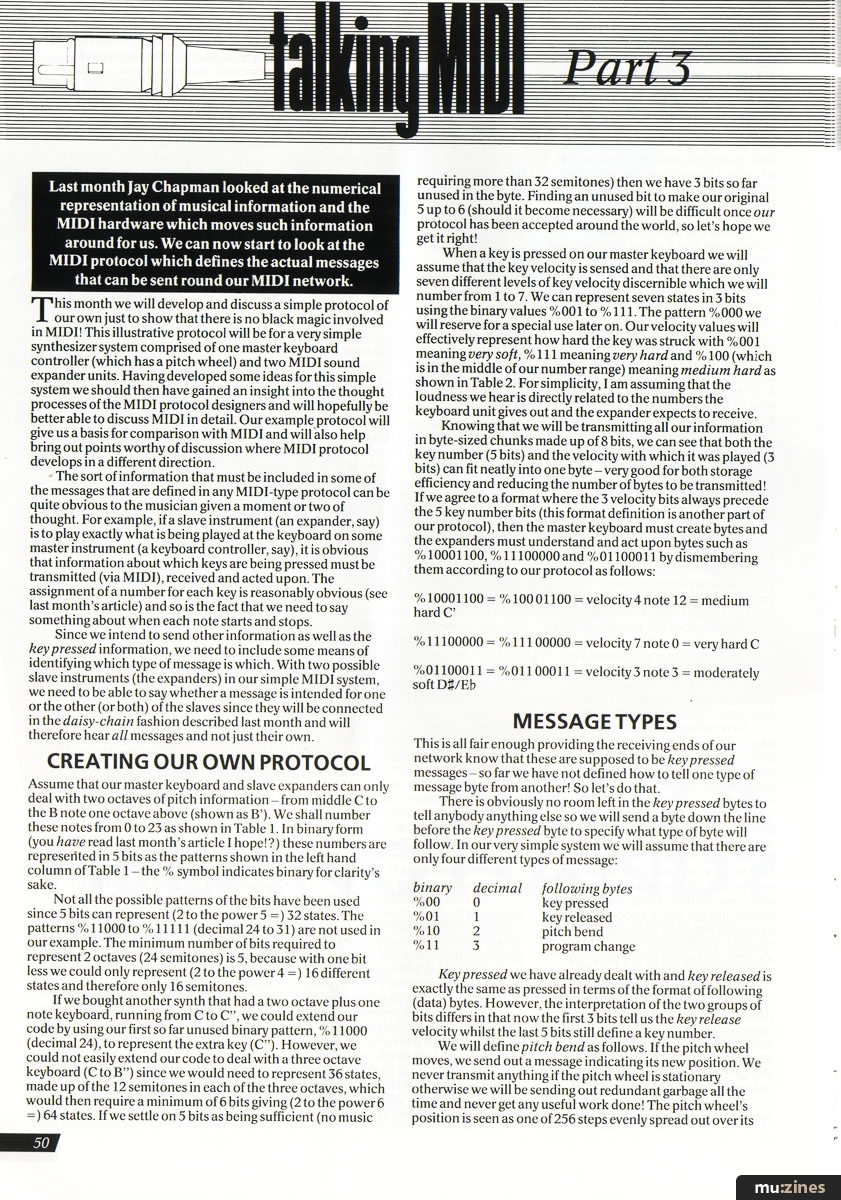
Talking MIDI, part three of a series on the protocol, Sound On Sound, February 1986, page 52. Read the article on mu:zines. Held as research material, credited to the magazine and to mu:zines.
The computer could make no sound of its own, due to the technological limitations of the time. The hardware could not provide sequencing on a large high-resolution display, for the same reason. Records and compositions were therefore made with the computer and the instruments together, connected through MIDI. The “MIDI era” time window opens when that arrangement became the standard way of producing records and composing for films in the years after the MIDI protocol of 1983. The window closes when a single computer was used for the entire production and this became the standard, at which point the computer came to mirror the studio.
About 1983 to 2005, in four phases.
Period covered
The window runs from about 1983 to the late 1990s. Its core is about 1985 to 1998, the years in which the arrangement was the working method. The years of widest use are about 1987 to 1996, ending when audio arrived inside the computer. The period divides into four phases.
Emergence, 1983 to 1985
MIDI was specified in 1983. It came into commercial use almost at once, with the Prophet 600 and the Jupiter-6 among the first instruments to exchange instructions. The affordable home computer carried MIDI. The Atari ST of 1985 shipped with built-in MIDI ports, which made it a low-cost sequencing platform.
The Commodore 64 and the Apple II reached MIDI through third-party interfaces. Early sequencers date from this window, among them Passport’s, Dr T’s, and Steinberg’s Pro-16 of 1984 and the Pro-24 that followed it. The workflow was already recognisable. Its users were enthusiasts and professionals who adopted it early.
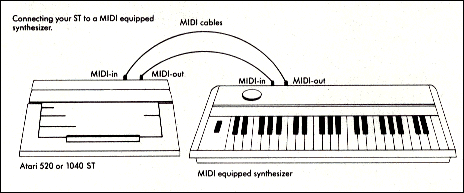
Instruction on how to connect your ST to MIDI equipment circa 1985
Consolidation, 1986 to 1990
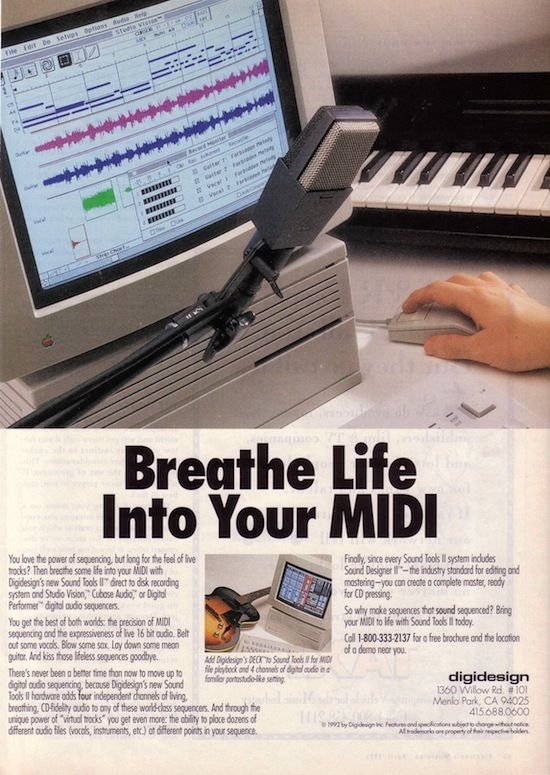
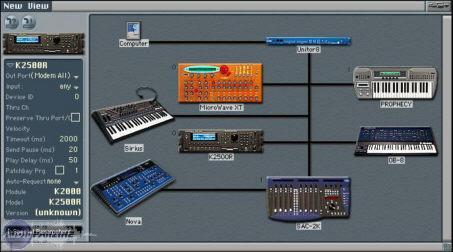
In these years the hardware and the computer together became standard in professional practice. The Atari ST became the working studio computer, because it was the inexpensive machine with the ports the standard needed built in. Steinberg Pro-24, Hybrid Arts SMPTE Track, Dr T’s KCS, and Opcode’s Vision and Studio Vision on the Macintosh made the sequencer central to the studio. Librarian and editor software, Opcode Galaxy, Dr T’s, and later Emagic SoundDiver, made the programming of instruments with limited front panels practical.
The synthesisers of the period were designed on the assumption that a computer would be used alongside them, because their own panels gave access to only part of what the machine could do. They include the DX7 and its successors, the Roland D-50, the Korg M1 and later the Kurzweil K2000 of 1991. Film and television composers adopted the model quickly, because sequencing locked to timecode let them present mock-ups and deliver scores with a flexibility that tape-based multitrack did not offer. Hans Zimmer and his circle are among the examples usually cited. Samplers did much of the sound generation beside the synthesisers, the Fairlight and the Synclavier first, and from 1988 the Akai S1000.
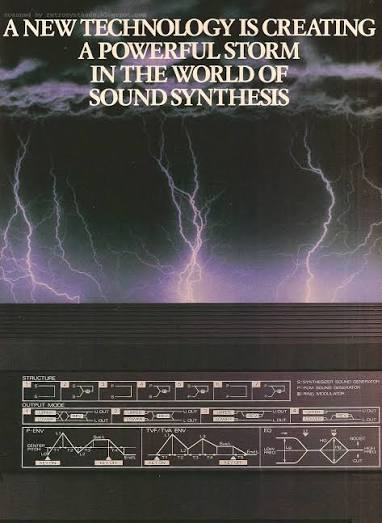
Advertisement for L.A. Synthesis circa 1988
Mature standard, 1991 to 1998
Cubase and Logic, Notator first and Logic from 1993, added notation, editing and arrangement to MIDI sequencing, and Digital Performer did the same on the Macintosh. Hardware was now also available as rack modules, which suited the computer in the role of controller. Orchestral and sample-based film scoring ran routinely on networks of samplers and multitimbral modules driven from a single computer. The hybrid workflow is at its most developed in these years. For control, editing and recall, the computer was indispensable, because that is where the arrangement was stored and seen. The sound remained largely hardware, because the software of these years could not yet generate it.
Emagic SoundDiver
Transition, 1996 to 2005
Several developments eroded the model in the same years. Cubase VST of 1996 brought native audio and plug-in instruments, which let the computer generate the sound as well as the sequence. Reason of 2000 offered a self-contained software studio. Pro Tools moved from dependence on its DSP cards toward native systems. Faster processors, cheap hard disks, and software samplers, GigaStudio of 2000 and then Kontakt, made production inside the box feasible.
Film scoring had largely moved to software samplers by the early 2000s. Hardware stayed more prominent in electronic music and in individual studios. Laptops became powerful enough for this work inside the box. They were then used on stage for live performance, which reduced the need for physical hardware there.
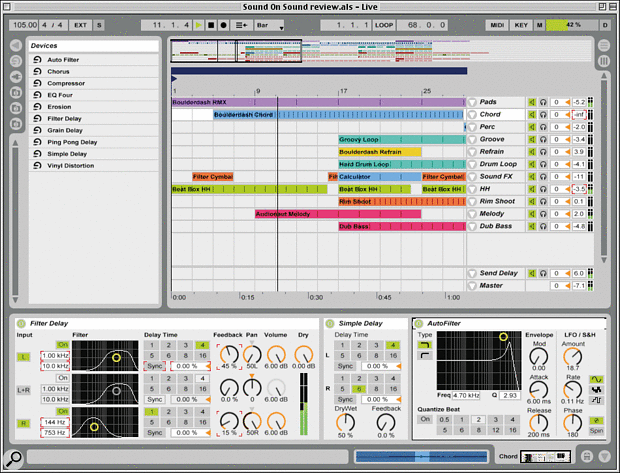
Ableton live as featured in its first review in 2002
The dating differs by sector and by region. Film and television adopted the hybrid model quickly and left it fairly early. Electronic and pop production kept hardware prominent for longer.
In Europe the low-cost Atari ST was more common than the Macintosh, which led in the United States. “Standard” here claims prevalence in commercial practice and not universality. It is therefore carried by cases and not asserted of the field as a whole. Such cases are the Atari ST in European studios and Opcode and MOTU in American film scoring. The account is read from the period’s own trade press, which Muzines gathers. There the picture of this window took shape for the research.
Rule-based and intelligent instruments, after Chadabe’s five milestones.
Machines of the period
The instruments here are the rule-based instruments and the intelligent instruments. The hardware and software of the period are described as legacy technology when the practice works with them. Memory was expensive, so a machine was built around a short set of rules that a person could learn in full. Everything such a machine could be asked to do could then be listed. A workstation of the end of this time window still worked the same way, because memory was still the limit it had been. The Kurzweil K2000 of 1991 is an example of such a machine, with its instructions written in software and its sound made by the instrument.
Chadabe (1997) is the history of the period drawn on here. He organises it by five milestones, each named for its technology. The account of the instruments and the ideas follows his.
Independent pioneers, often outside the academy and self-funded.
Software instruments and authorship
For this research, microcomputers became instruments of experimentation. Software and instrument development passed into the hands of independent pioneers. Game development followed.
The pioneers sometimes worked outside the academy. They paid for the work themselves. More people built software instruments than before. Each instrument set up its own relation between the person and the machine, so more of those relations were tried.
Added as the research runs.
Unforeseen
Here the unforeseen situations, sometimes difficult, sometimes unexpectedly interesting, will be described as the project runs. Many of these unforeseen situations have already occurred and have been recorded. They will be added in the time to come.