Part of Temporal Constructs Appendix, which contains details behind the research: dates, quotations, descriptions of instruments, and sources.
General definition
An experiment is a trial in which one or more conditions are changed deliberately, so that the effect of the change can be observed. The conditions held constant are stated with it where the trial is to be repeated by someone else.
Relation to the practice
The laboratory’s method of experimentation is exploratory. Conditions are rarely fixed in advance, and the improvisational parts of the work are themselves trials, so the record contains what was tried, what was read from the machine and what came of it. The experiments are stated here beside the discoveries they produced, and each instrument that has been tried is given a section of its own.
The work of this doctorate with artificial intelligence has been experimental throughout. No method existed at the outset for using a model inside instruments of the MIDI era. Learning to work with a model has itself been part of the research, and the feasibility of the practice was settled by attempting it. These trials are therefore recorded as part of the research itself.
Laboratory tradition
The laboratory is the established form of research in this field, and its instances share the following features. It is a place kept for the work, in which the instruments and the media are themselves the objects of study (STEIM). Production, teaching and research are held in one institution, so that what a trial establishes is passed on as it is established (Institute of Sonology, Mission (n.d.)). Its trials are exploratory, conducted where no conceptual framework for the phenomena is yet available and under no fixed hypothesis (Steinle 1997). Its results are carried into public work, and its means are handed to others.
Temporal Constructs is a practice of that form, and CONDUCTOR is its laboratory. The record gives CONDUCTOR that role. It is the staging environment in which the instruments and languages of the MIDI era are studied, among them M, Trip-A-Tron, KML, HMSL and the Kurzweil K2000 (CONDUCTOR technical notes). The results are carried into public work in ALTERITY and into teaching in the masterclass of 4 March 2026 (In Conversation with Your Instrument). The framework is handed over for others to take up, which is how its transferability is tested.
The earliest instances are the BBC Radiophonic Workshop, founded in 1958 for the production of sounds no existing source could supply. The Zodiak Free Arts Lab follows, opened in Berlin in 1968 as a room for free improvisation. The Dutch line begins at the NatLab, the research laboratory of Philips opened in Eindhoven in 1914, whose acoustic department employed Dick Raaijmakers from 1956. It continues at the Institute of Sonology, whose work rests on production, teaching and research. V2_ supplies the term for this class of media, which it describes as unstable.
The same form was applied to instruments at STEIM and to the collaboration of an artist with a research scientist at Bell Laboratories and E.A.T.. The Media Lab conducts its work in spaces that no established discipline accommodates, and the Kling Klang studio of Kraftwerk is a studio kept closed by the band (Terstiege 2021). Max took its modern form at IRCAM between 1985 and 1990, and HMSL was written at the Center for Contemporary Music at Mills College. V2_Lab and Thunderboom Records are the present instances and both are stakeholders of this doctorate, named in the application of April 2025 and research partners since late 2025. Gardner’s practice took the form of a laboratory before the doctorate. Its first result is the master’s thesis of 2012 on the studios and engineers of the Dutch psychedelic and beat sound (Gardner, Phonogram in de jaren '60 (2012)).
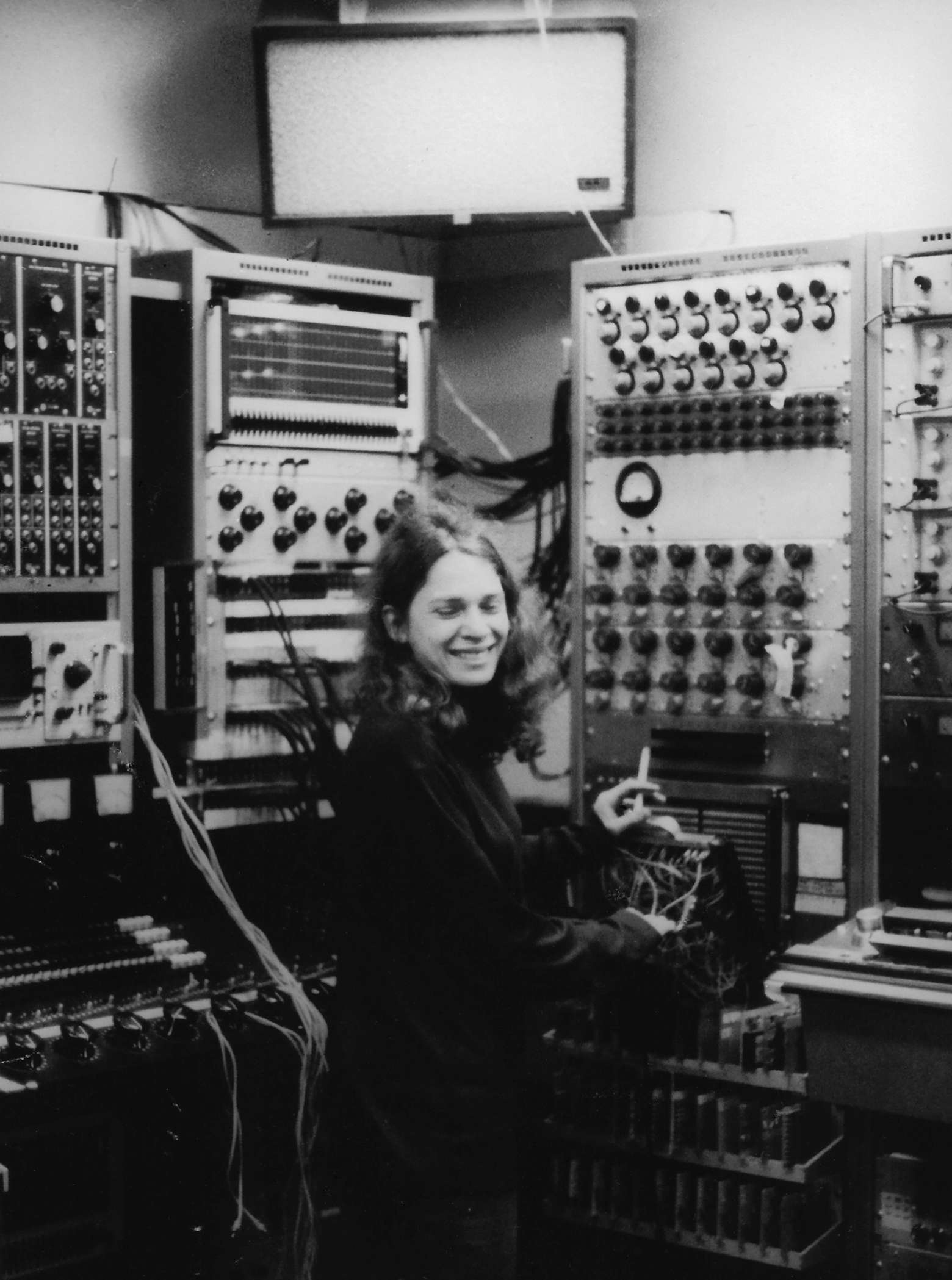
Laurie Spiegel at Bell Labs, late 1970’s.
Experiment and discovery
An experiment is a change made on purpose, followed by an outcome read from the machine in rehearsal or in performance. Its entry on this page names what was changed, by whom, and what was seen. A discovery is the other case, a result the work produced that was not sought, and it remains on its own page with the material that shows it. The two pages are read together. An experiment may produce more than it was designed to test.
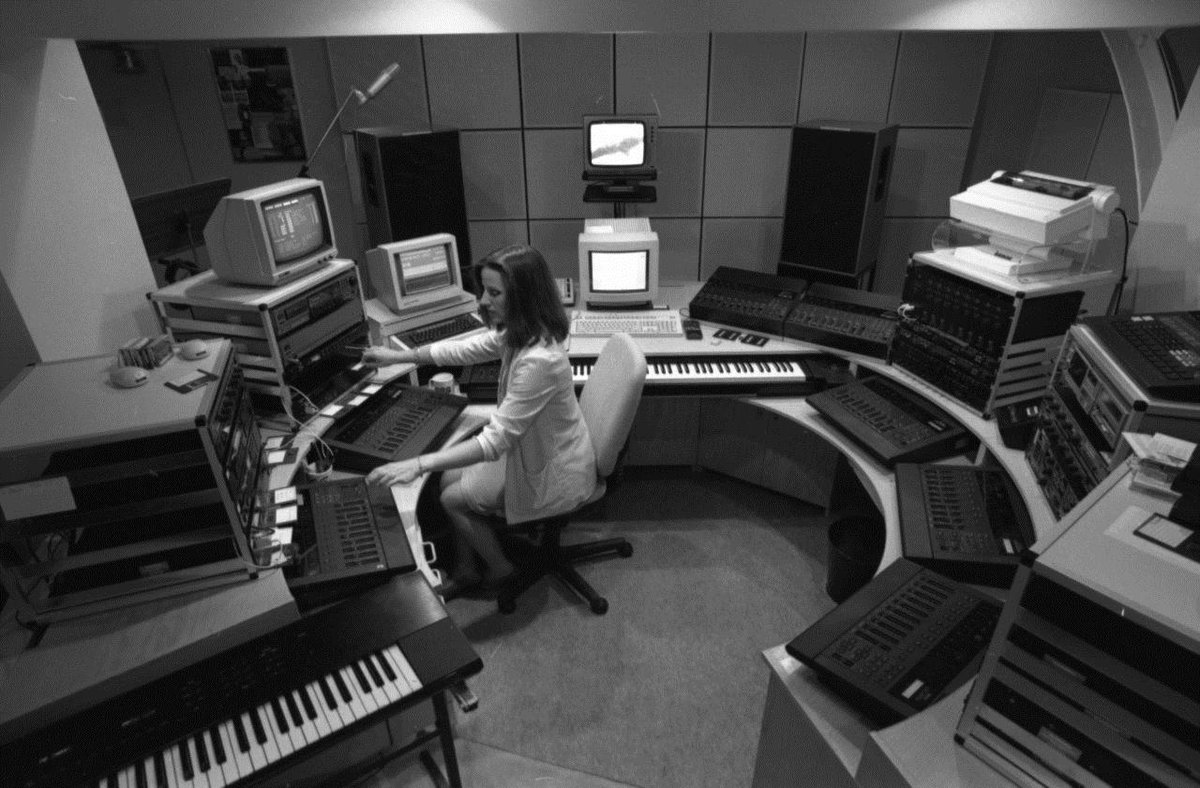
Elizabeth Parker in Studio F (Room 21) of the BBC Radiophonic Workshop in 1989
Experimentation Method
Improvisation is a working condition of the practice, so a trial frequently changes character while it runs. One trial may begin as a test and continue as playing, and another may begin as playing and become a test. Open conditions allow an instrument to be tried in ways its designers did not intend, and the practice’s findings came largely from trials of that kind.
The method is exploratory in the sense that term carries in the study of experimentation. Steinle 1997 gives the name exploratory experimentation to work of this kind. It is conducted where no conceptual framework for the phenomena is yet available, and where no hypothesis governs the trial.
Stojanović 2013 sets out the guidelines Steinle attaches to it. Many parameters are varied, and the conditions essential to an effect are separated from those that modify it. Stable empirical rules are then sought, and simple cases are constructed in which those rules are seen clearly. The method is sound because of these open trials, and the discipline they keep is constant: every result is read from the machine and checked against it.
M
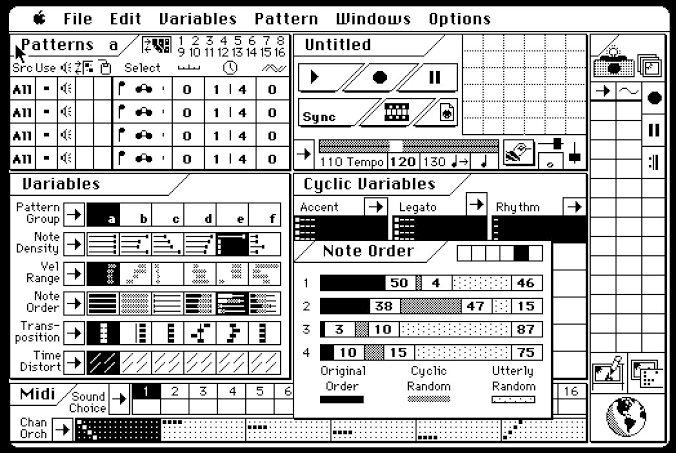
The sequencer M was driven by the voice, with one model transcribing speech and a second judging whether the input was a human voice. The trial was made for the masterclass of 4 March 2026, and it is recorded on In Conversation with Your Instrument. The same control system was later given to the agents, which let them operate M directly. The record counts that result as an agent-initiated use of the instrument, and it is held on Discoveries.
Trip-A-Tron
Before an agent could compose in the Trip-A-Tron editor, a navigation and verification layer was built for it, and optical character recognition was written to read the screen. The editor has no draggable windows, so each screen can be mapped in advance, which is the condition of reliable reading. The case is held on the Session record.
KML
Agent-written code was transferred into KML, the language of the Trip-A-Tron editor. The transfer works and is not yet dependable. The Session record holds the case as one of the sessions that can be dated and quoted.
HMSL
Composing in HMSL was carried to a public occasion. Agent-composed music in the language was played at Human After All? at Time is the New Space in Rotterdam on 1 May 2026. The occasion is recorded on Human After All 2026.
Kurzweil K2000
The interface of the Kurzweil K2000 is carried over MIDI, so its screen can be read and its buttons pressed from a program. The agents mapped its factory presets until the workflows of the machine were understood, and a model could then operate it as a human operator does. The mapping is recorded as a discovery of the first year, and its method is on the machine’s own page.
Roland S-series
The sampler generated the sound for the demonstration of M, which made none of its own and sent instructions instead. A Roland S-330 of 1988 was the machine used, and its four voices were mapped to four speakers for quadraphonic sound. The demonstration is recorded on In Conversation with Your Instrument.
Atari ST
An Atari ST runs Trip-A-Tron in ALTERITY, supplied by MiSTer reconstructions of the machine. An original stands in the installation and is shown at the points in the narration where the machine is the subject. The machine is driven by an agent through optical character recognition, and its fixed screen layout allows each screen to be mapped in advance. The arrangement is described on the machine’s own page.
Macintosh SE
A Macintosh SE of 1987 runs the sequencer M, which makes no sound of its own. In the masterclass of 4 March 2026 its four voices were mapped to four speakers. A light system made its decisions visible, so what the sequencer decided could be seen as well as heard. The demonstration is recorded on In Conversation with Your Instrument.
Macintosh SE/30
A Macintosh SE/30 of 1989 runs Max, written by Miller Puckette in the mid-1980s. In the design of June 2026 it is the cockpit showing the whole system at once. The connections it draws are passed to the agent, while the real ones live on the Raspberry Pi. The design is set out on CONDUCTOR technical notes.
MiSTer
The installation runs Trip-A-Tron on MiSTer reconstructions of the Atari ST, with three boards supplying one core for each screen. An original stands in the installation, not running. The arrangement is described on ALTERITY.
Raspberry Pi
The Raspberry Pi was stripped to MIDI alone and given a Pisound card, and a router was then written to open thirteen ports at once. Its first version suffered thread contention and echo floods. The file system held in memory discarded every write at reboot, so the system moved to an SSD under version control. The trials and their outcomes are on CONDUCTOR development history.
Max
In the first version the orchestrator was Max 2.0 on the Macintosh SE/30, with an Emagic AMT8 interface carrying the MIDI. Its preset objects held a whole state in memory and its line objects carried temporal effects, and the timeline sat outside the machine and sent recalls into it. What the Raspberry Pi, Pure Data and the agent replaced in June 2026 was that orchestrator, and the chronology is on CONDUCTOR development history.
Pure Data
Agents wrote Pure Data patches that worked, and they failed at the coordinates of patch points and at the placing of objects on the canvas. The patches were sound in their logic and deficient in their layout. The trial and its limit are recorded on Discoveries.
Strummer
Strums were composed with the Strummer, a device written in Max and Pure Data. A model chose twenty-four numbers inside a space of about 3.7 times ten to the fiftieth settings, and the result was a composition produced without generating sound. The composition is recorded on Discoveries.
Edirol V4
The video mixer was taken by an agent into turning the picture negative at moments the narration calls otherness. The action was not asked for, and it is held in the record as a case that bears on the thesis. It is recorded on Discoveries.
Martin MAC 250
The moving heads were driven by an agent into choreographies in which two fixtures take roles and interact with one another. The practice had brought the fixtures into the system for lighting and did not intend that use. The choreography is recorded on Discoveries.
Akai X201D
The narration is carried on a reel-to-reel tape machine, with SMPTE timecode on its second track. The machine is the Akai X201D, and the two tracks carry the narration and the synchronisation signal. The arrangement is described on ALTERITY.
Yamaha MSS-1
The Yamaha MSS-1 reads the SMPTE timecode on the tape’s second track. It converts that timecode into MIDI, which fires the scene changes and the system states across the three towers at once. The trial is the synchronisation of the whole installation to a recorded narration, and it is described on ALTERITY.
Heathkit OP-12
A laboratory oscilloscope of 1958, sold as a kit with assembly manuals that included a full theory of operation, renders the narrator’s voice as a waveform. A live camera carries the trace onto the screens, so the voice is turned into light in the installation. The machine is the Heathkit OP-12, and it is described on ALTERITY.
Outstanding register
Every trial above reaches its machine through MIDI, and the lighting through DMX. What is missing is the detail of each trial: the date, what was changed, what was held still, who ran it and what was read from the machine. That work was not carried out before this page was made, and a trial written from memory alone cannot be checked against the machine. Four instruments have no experiment recorded yet and therefore no section here: Music Mouse, Jam Factory, the Yamaha FB-01 and the Faderfox EC4. The register is therefore incomplete, and it is recorded as such.
Unforeseen
Here the unforeseen situations, sometimes difficult, sometimes unexpectedly interesting, will be described as the project runs. Many of these unforeseen situations have already occurred and have been recorded. They will be added in the time to come.