Part of Temporal Constructs Main Text, which states the research questions, the proposals, the work done and what is still open.
General definition
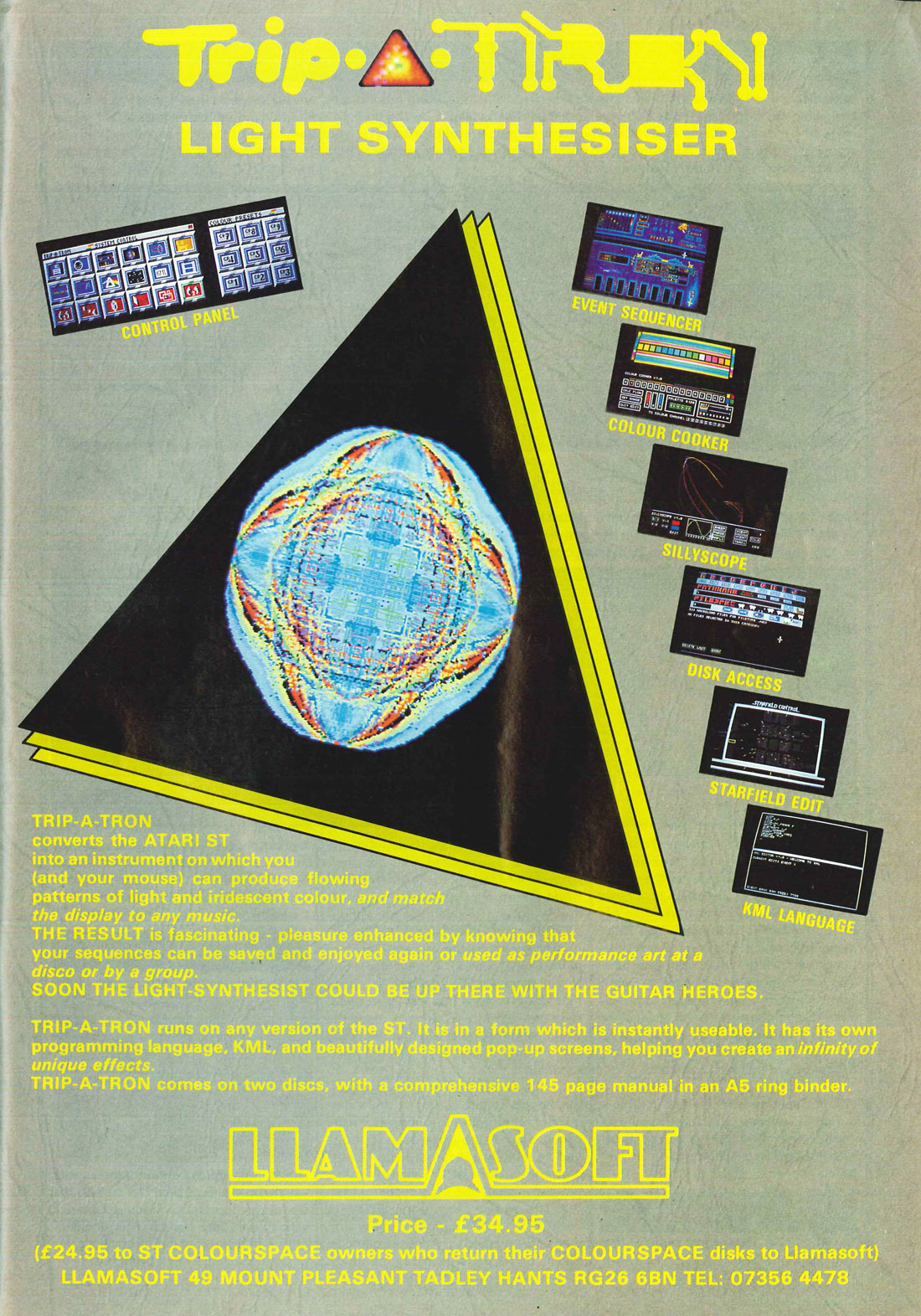
Trip-A-Tron is a light synthesiser for the Atari ST. Jeff Minter of Llamasoft wrote it in 1988. It generates real-time visuals and is programmed in its own language, KML.
Relation to the practice
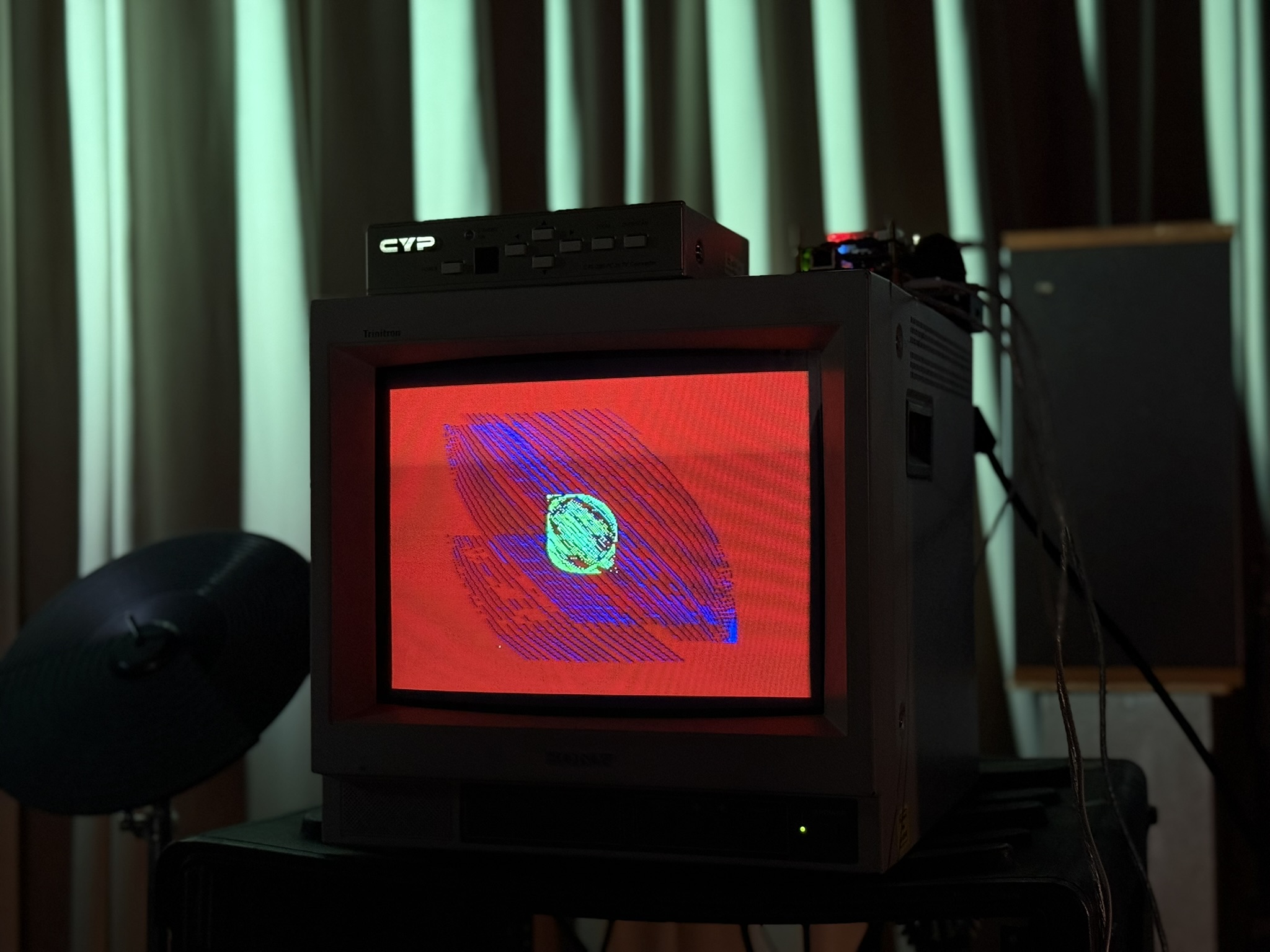
Trip-A-Tron runs in ALTERITY and is central to the doctorate’s work on orphaned languages. Agents populate its editor with KML compositions under emulation, and its combination with MIDI instruments is a starting point for visual music.
It drives real-time visuals from MIDI and offers a small language of few commands and simple syntax, which introduces programming to a new user without overwhelming them, and gives more than the interface alone could. Jeff Minter set out to build an ecosystem in which playing is the point, and not virtuosity or a high score, and he described the practice as messing around and enjoying the wonder. Minter’s account is the doctorate’s case for play as the ground of creative work. The instrument makes that case available to a person and to an agent alike. An independent game developer working outside the academy, who knew John Whitney‘s abstract films before he began, made it. It was a commercial failure with a small surviving community, though it still runs.
Operation by agents
Agents populate the editor with compositions in KML and transfer the code they write into the running instrument without a person at the keyboard. The work on orphaned languages reaches a machine that still functions. The pipeline works but is not yet dependable, and making it dependable would put the instrument within reach of practitioners other than Gardner.
Surviving record
The instrument’s own record is intact. Minter wrote the user manual himself, and the machine comes with demonstration programs whose code is his as well. The clearest work made with it alone is Merak, the 1988 film with Adrian Wagner, whose visuals were performed live through Trip-A-Tron and scripted in KML. It may be the first feature film made in full by one person on personal computers, working independently, though that is not confirmed. Sound and visuals were performed live in full, and Merak turned this into a cinematic audiovisual experience to a science-fiction narrative.
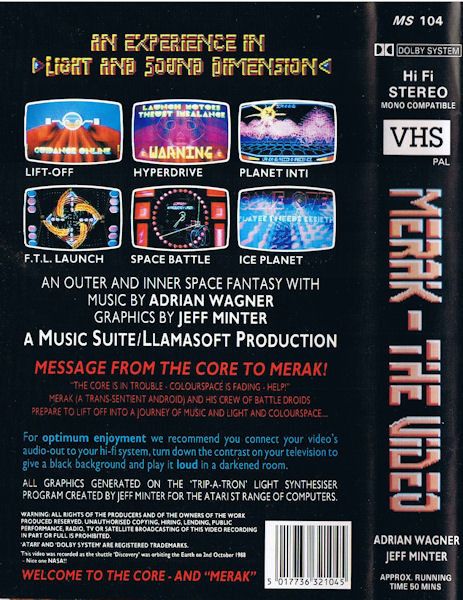
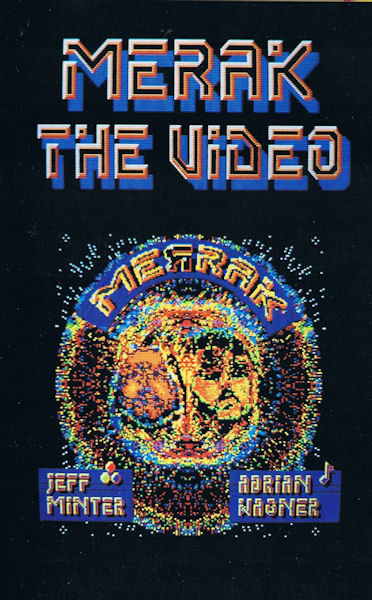
Merak (1988)
It can be watched in full on Youtube: https://www.youtube.com/watch?v=zeSfpVJExoI&t=124s
Instrument properties
A review of the work describes it as possibly the first program designed to translate MIDI directly into analogue video output. That property is the one the system depends on. The imagery in ALTERITY is generated from the same data that drives the music, so what the audience sees is the compositional process itself.
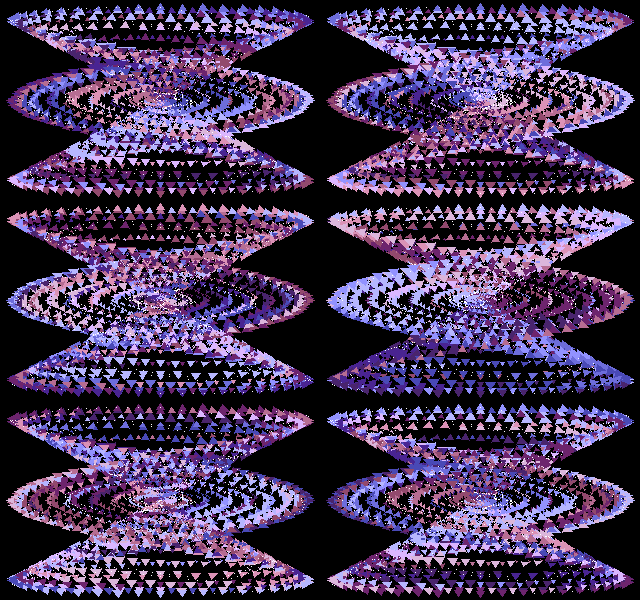
Trip-A-Tron used palette cycling with a maximum of 15 colors to create a sense of movement
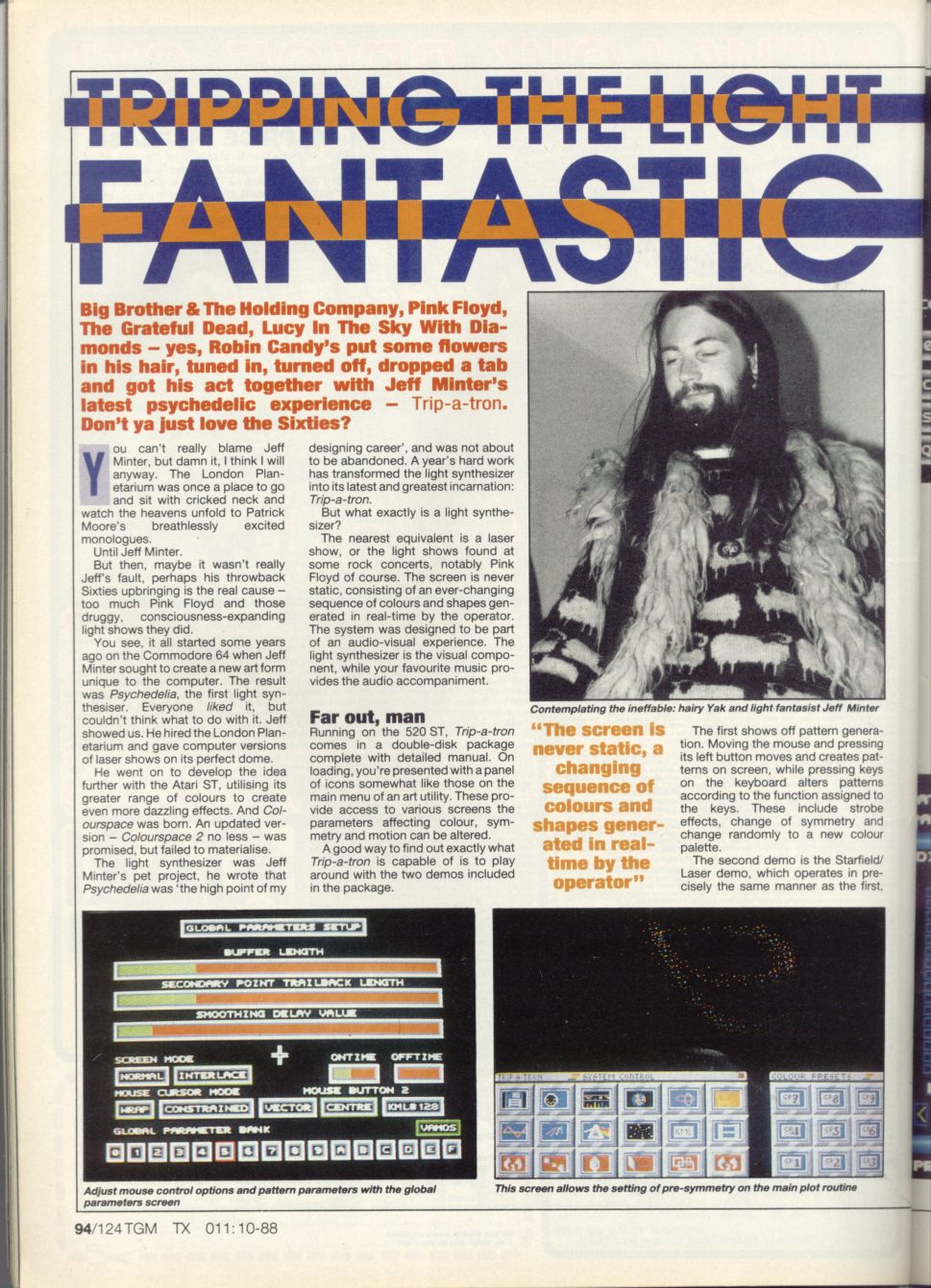
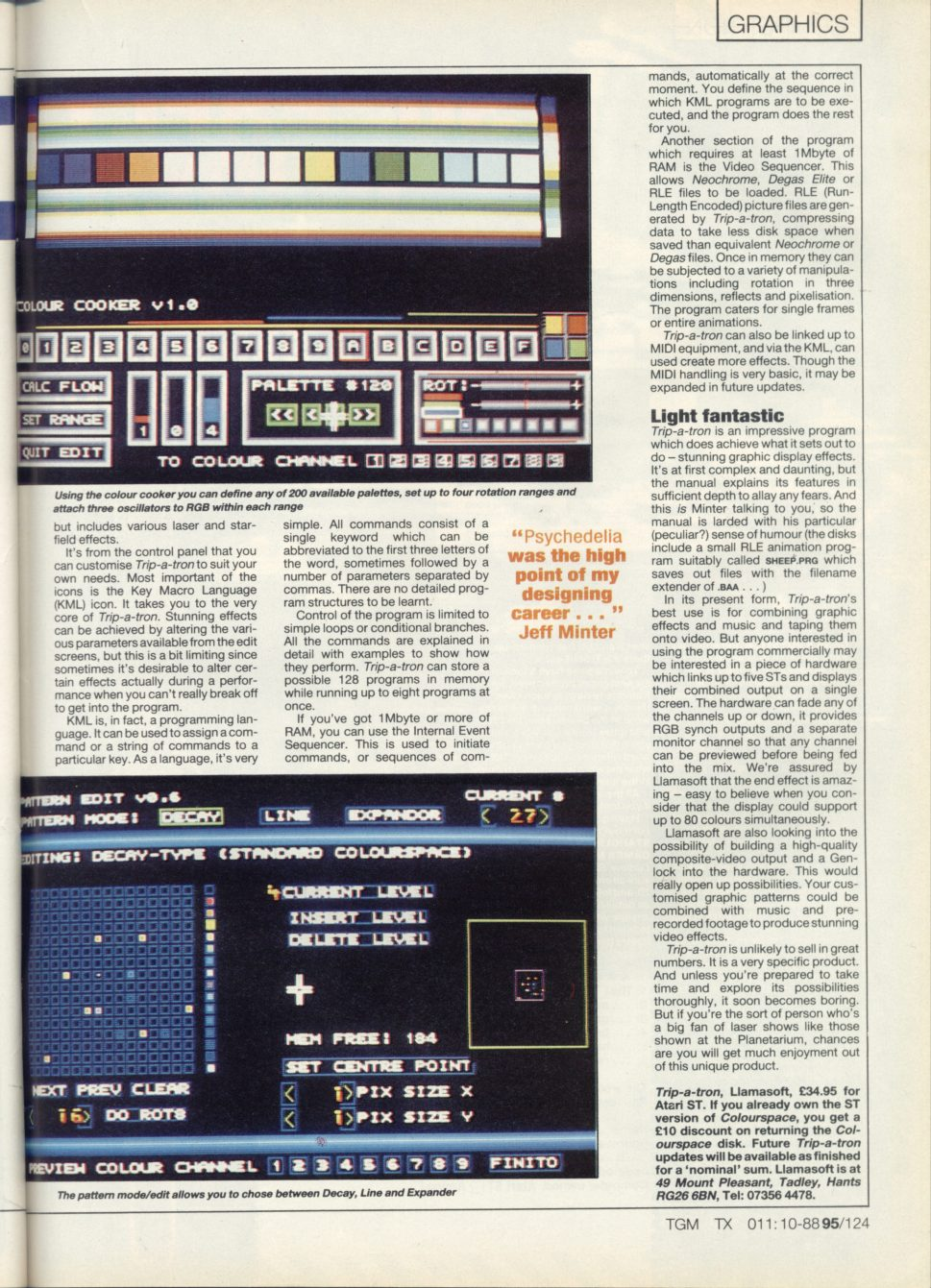
Computer Magazine - The Games Machine (Oct 1988)
https://amr.abime.net/review_47652
The Games Machine 11 (Oct 1988)
Trip-A-Tron was the first light-synthesizer I had seen, and the first visual instrument I had ever used. I had worked with interactive lighting systems before using MAX/msp and DMX but not with visuals and generative projections. The other light-synths that Jeff Minter made did not have MIDI, so they relied on a separate visual performer to follow the music. The light-synths that came after Trip-A-Tron were again reliant on the visual performer, and the musical agency was reduced and as they did not have MIDI support, they are less suitable for Visual music, where the line between the visual and the musical blurs. Trip-A-Tron with its MIDI support was possibly the first MIDI controller visual instrument, working similar to a sound synth, presets could be programmed in KML, and then become useful during live performance where visual changes could have a direct effect on the way they are performed. I think it’s a radical attempt at exploring what interactive computers could become, and it occupies an interesting place between playing musical instruments and playing videogames.
artist statement
Unforeseen
Here the unforeseen situations, sometimes difficult, sometimes unexpectedly interesting, will be described as the project runs. Many of these unforeseen situations have already occurred and have been recorded. They will be added in the time to come.