Part of Temporal Constructs Appendix, which contains details behind the research: dates, quotations, descriptions of instruments, and sources.
General definition
An open source agent framework that Nous Research published in February 2026. It runs as an autonomous agent with tools, and it maintains a library of skills it writes itself, which makes it a self-evolving framework. It is model-agnostic, and it can run on a rented server, a single-board computer or a host that sleeps when idle.
Relation to the practice
The framework runs on a Raspberry Pi 4 and a rented private server, and the user reaches it through Telegram and the CLI. It has worked with HMSL it populated KML compositions into Trip-A-Tron, it developed and worked with CONDUCTOR and Conductor Unified Execution and it maintains this archive. It is the intended orchestration layer of CONDUCTOR, and the doctorate studies it while using it. Using Hermes Agent helped move dependence from closed source APIs to open-source locally owned data.
Role: research tool (language recovery, CONDUCTOR development, archive maintenance)
Role: object of study (self-evolving multi-agent framework)
The framework writes skills from experience and improves them while they are in use, revises its memory and recalls earlier sessions. A skill is written as a file, so it can be carried between installations. A companion project from the same laboratory evolves those skills, the tool descriptions and the system prompts by search over text, and trains no model weights.
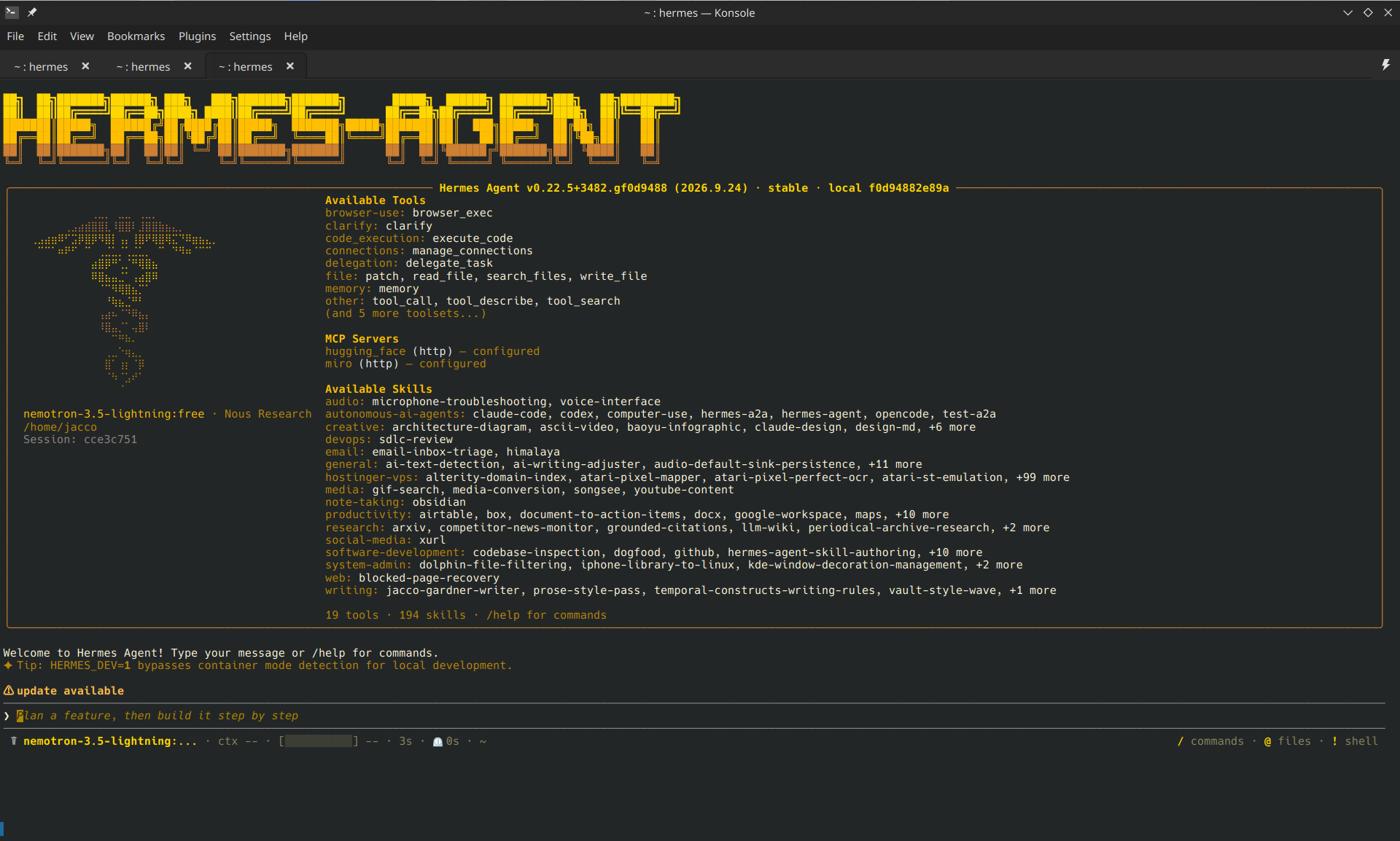
Hermes Agent version 22, November 2026
Nous Research is the company that makes Hermes Agent, and its stated intention is to keep intelligence open. Its mission is to create and proliferate open access to intelligence, which it describes as the internet’s own AI, and it holds that powerful artificial intelligence should be in the hands of the many rather than the privileged few. The company trains models, builds agents and develops infrastructure to that end, and it publishes Hermes Agent under the MIT licence, so the program can be run, read and changed by anyone. Its research is directed at agents, model architecture, data synthesis, fine-tuning and reasoning. Hermes Agent is where those principles meet this practice: an agent that runs on a local machine, keeps its memory in files its owner can read, and can be replaced or abandoned without the work being lost. A description written for a general readership, outside this archive, is at Hermes Agent, the self-improving agent, which sets out how the program writes skills from its own experience.
Click a section title below to open that section.
April 2026, in the doctorate’s first year.
Arrival of Hermes Agent
The framework was published in February 2026. It arrived in the practice with the doctorate’s first year already running, and the earliest session in the practice’s own archive is dated 22 April 2026. In June 2026 it moved onto the artist’s own machine, and it changed the shape of the practice from there. The machine the doctorate now works from carries a later installation, of 31 October 2026, which is a second installation and not the first use.
Hermes Agent version 1 released in February 2026.The doctorate records the arrival as an unintentional change, and it does not present the year as though it had been foreseen. The plan’s sequence could not be kept, and a capability that arrives can also be changed or withdrawn by others.
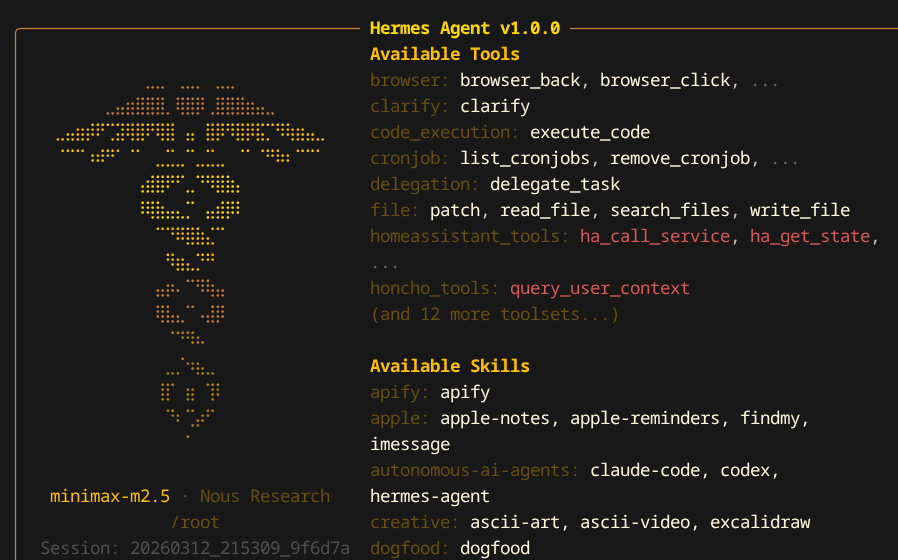
A rented server, a Raspberry Pi, then the artist’s own machine.
Implementation into the practice
The framework was first deployed on a rented server away from the artist’s computers. It then ran on a Raspberry Pi, and in June 2026 the doctorate moved it onto the machine itself, because the container blocked access to the sound devices that the MIDI router needs.
Its persistent memory fills quickly, so the memory is kept small and used mainly to point elsewhere. The bulk of what an agent is given is written into an instruction file it reads at the start of its work, as in an instruction file of this kind, and each kind of work is given its own channel, so an agent working on the lighting does not carry the language port in its window.
The framework handles the mechanics alone, writing memory, keeping the instruction file in view and routing a call to a model. Judgement stays with the operator, who decides what the memory says, what belongs in the instruction file and what an agent must not be shown. Irrelevant context costs money and misleads.
Hermes Agent, image from the Nous Research website
OpenRouter and Nous Portal, neither retaining the data sent.
Inference
Model calls (Inference) go through OpenRouter and Nous Portal. Both serve inference without retaining the data sent, which is the condition the practice’s guidelines set, and both allow one model to be exchanged for another without a change to the framework. That ease is what makes the testing of models part of the method. The doctorate runs models of different sizes and finds no single order from small to large. The smaller models it can afford confabulated from time to time, and larger models used at time-sensitive moments failed on problems that a smaller one later solved. Behaviour depended on the task, on the tools given and on the week of use, so the cost of each task is measured.
The available models also changed, because the routing service withdrew or replaced them. Especially in the beginning trying them out became an ongoing task, carried on inside time-sensitive engineering work. That is a condition of the method, and one reason the doctorate argues that its tools and eventually its own fine-tuned models should be its own.
The models come from makers in the United States, China and Europe, and they run under one harness. Under those conditions, what a single model contributes of its own becomes difficult to separate from what the arrangement contributes. In that sense there is more focus on what the Hermes Agent framework contributes than focusing on each AI model used and how they differ, which while useful would be a significant research challenge of its own.
The skills, the instruction files, the memory and the tools belong to the Hermes Agent framework and remain in place when the model behind them is replaced so there is no dependency on closed-source AI frameworks. An identity forms over that time, and it lives apart from the inference engine. This is a further distribution of authorship, and it is why the configuration is used here.
The doctorate costed running the models locally in October 2026. Adequate quality would cost 2,500 to 3,500 euros and comfortable quality 5,000 to 7,000, on a work station and not on a laptop, while the smallest code-oriented builds run on a 16-gigabyte card with 32 gigabytes of memory. A single small top-up to the routing service raises the daily request ceiling from fifty to a thousand, and fall-back routing spreads the load across providers. Whether its prompt-caching discount reaches the user remains open. The legal position was checked as well. The European Union and the United States both allow the private use of Chinese models through such a service, and the binding constraint in Europe is data protection rather than export control.
Behaviour set by the skill and instruction files of this practice.
Bias and specification
Its rules here are not fixed in advance. They are the skills and instruction files written for one practitioner and revised as the practice changes, so the behaviour a reader of this record meets is set by this practice rather than by a supplier. Training data is commonly said to leave a language model with a bias of its own, and the doctorate does not claim that the arrangement removes it. What changes is where the rules sit, in files the practitioner can read, contest and rewrite rather than only in the behaviour of a service.
What an agent works with is a position reached with one practitioner, and the position changes as the files change. Nothing in it is settled once, and the changes are dated in this record. The learning loop makes the arrangement self-evolving within the practice. What an agent learns in one task is available to the next, and the doctorate uses that movement as material rather than as a convenience.
Agent reports tested against the machine, a rule settled in July 2026.
Reports and evidence
A rule was settled in July 2026, that an agent’s report is not evidence until it has been tested against the machine. The rule came from failures that were fluent, and they are dated. A passage written in March 2026 about the sequencer pioneer Ralph Dyck carried invented details. In May a model of cognition attributed to the psychologist John R. Anderson turned out to be confabulated, a piece by David Rosenboom was presented as HMSL when it is not one, and Marvin Minsky’s Society Of Mind was dated before the language began. In June a claim about a written prediction was traced to a summary of a book rather than to the book, and in July an architecture reported as running under the name Fabric was largely invented. In October the transcript of an interview carried a wrong date of death for Polansky, a misspelled surname and a drifted chronology, and a quotation in a funding text could not be found in the source it was attributed to.
Claims are tested against raw output that the artist reads, reference documents are written from what is verified, and a protocol is agreed for checking an agent’s reading of a screen before any input is tested. One agent deleted the system’s codebase, and another reconstructed it while mixing three generations together. When MIDI messages stopped reaching the lights, the doctorate built a diagnostic that watches the signal where it enters the patches rather than blaming a part of the chain nobody can observe.
Added as the research runs.
Unforeseen
Here the unforeseen situations, sometimes difficult, sometimes unexpectedly interesting, will be described as the project runs. Many of these unforeseen situations have already occurred and have been recorded. They will be added in the time to come.