Part of Temporal Constructs Appendix, which contains details behind the research: dates, quotations, descriptions of instruments, and sources.
General definition
A German group whose work began with the Kling Klang studio, opened in Düsseldorf in 1970. Its music takes the relation between people and machines as its subject as well as its method, and the man-machine is among its themes, together with the human as machine. Its stage presentation is as consequential as its records. The group took the equipment of the studio on tour and treated it as the instrument of the performance.
Relation to the practice
Kraftwerk is the precedent for the stage itself. The design of CONDUCTOR for ALTERITY draws on it in the screens the work uses. It draws on it too in the principle that the visual side is part of the instrument and not decoration. Its subject matter is also the subject of this research. It put human-machine relations, the machine as a human and the human as a machine, on stage as questions.
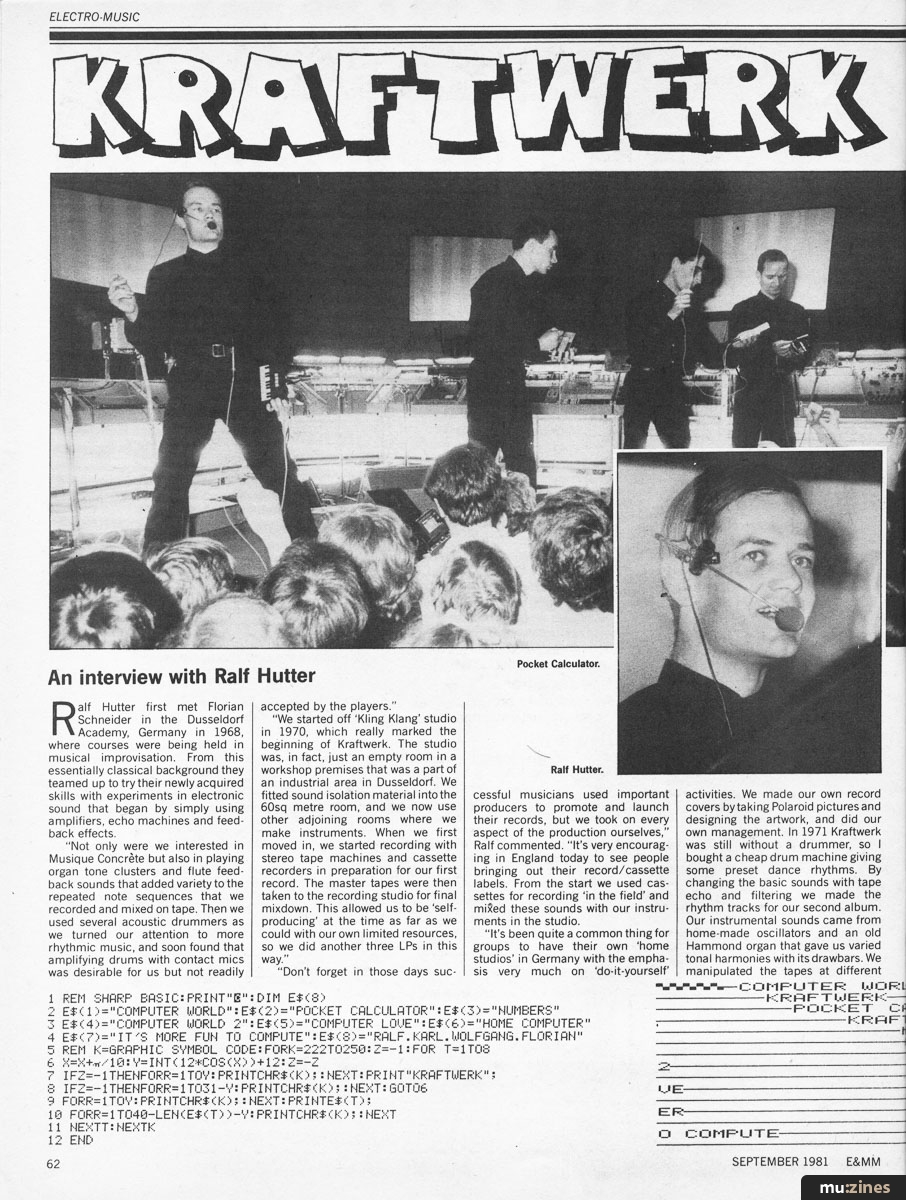
Kraftwerk Revealed, an interview with Ralf Hutter in Electronics & Music Maker, September 1981, page 64. Read the article on mu:zines. Held as research material, credited to the magazine and to mu:zines.
It was the first group to tour with visuals made for the tour, and the first to bring a studio on the road and perform with the laboratory. The practice responds with a machine that collaborates, and not one that is admired or feared.
Kling Klang touring
The Kling Klang studio toured. Between The Man-Machine and Computer World the group designed a stage set to bring the studio on the road. Ralf Hutter played at a stand of three keyboards, a Minimoog, a Polymoog and a custom-built one. The visuals grew alongside it, and static slides appeared at some concerts from 1975.
By the Computer World tour of 1981 there were back-projected slides and films synchronised with the music, shown on screens made for the purpose. The music and the image operated together in the live situation. Hutter described the result in his own terms later. He said that the group had become a space laboratory, able to land anywhere provided it had the projectors and the screens. The beginnings of the Kling Klang studio are described by the group itself in an interview held in Muzines, published by Electronics and Music Maker in 1981. The masterclass In Conversation with Your Instrument used a clip of the group performing with the setup it had built, as the case of a laboratory used as an instrument.