Part of Temporal Constructs Appendix, which contains details behind the research: dates, quotations, descriptions of instruments, and sources.
General definition
An American inventor and technologist. His reading machines for blind people were among the first commercial uses of pattern recognition, and he published The Age of Intelligent Machines in 1990. He later described the arrival of the Singularity, a moment in which he expects humans and machines to merge.
Relation to the practice
Kurzweil’s company released the Kurzweil K2000 in 1991, the year after the book, and that machine is the single sound source of ALTERITY. His transhumanist future is the horizon the work’s narration sets the machine against. The doctorate takes the position he is quoted on in the work’s record, that the role of the computer is to amplify human creativity.
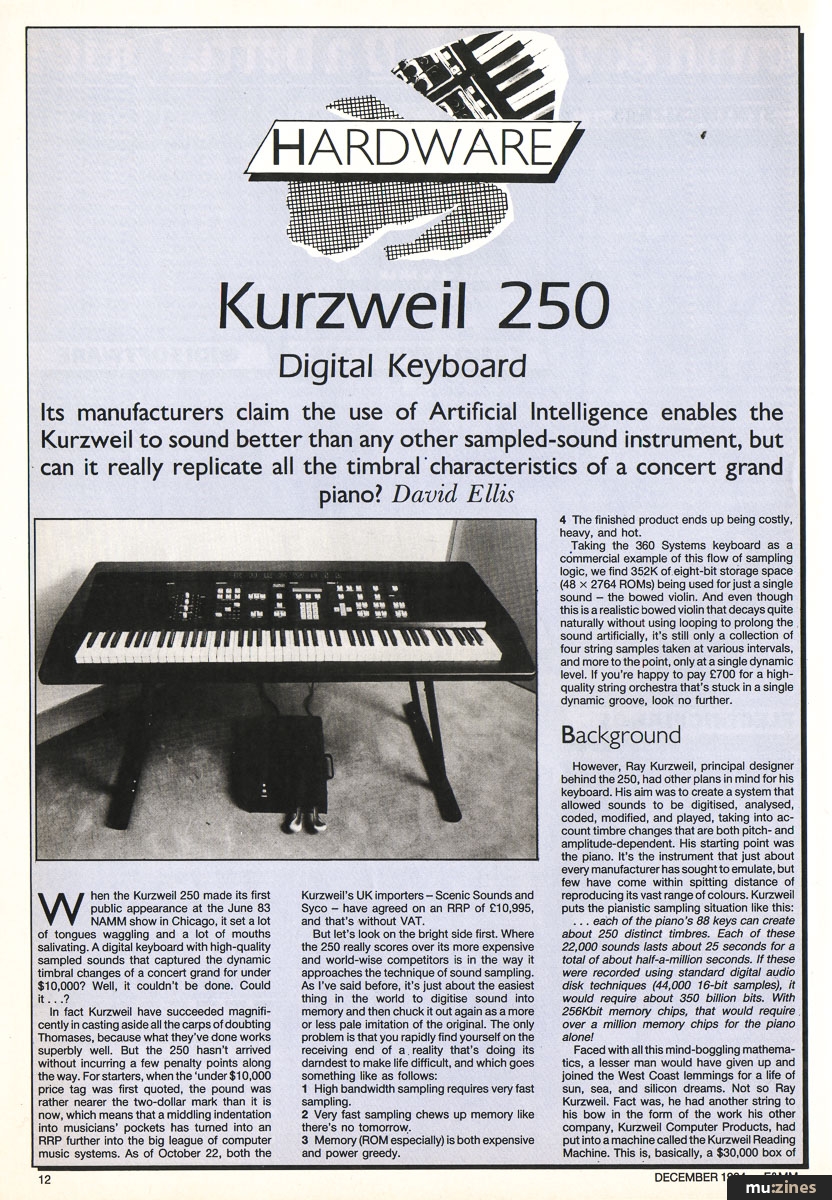
Kurzweil 250 Digital Keyboard, a review that asks how artificial intelligence can be used to make an instrument sound like a grand piano, Electronics & Music Maker, December 1984, page 14. Read the article on mu:zines. Held as research material, credited to the magazine and to mu:zines.
Contribution to possibility
The machine is designed so that its possibilities are open to others. Its front-panel buttons and its display are exposed over MIDI, and its maker published the data format, so a program can reach the machine without reverse engineering. Those decisions are the developer’s contribution to what is possible, and the doctorate’s use of the machine rests on them (Constraint).