Part of Temporal Constructs Appendix, which contains details behind the research: dates, quotations, descriptions of instruments, and sources.
General definition
The account ALTERITY gives of itself, and the argument it makes about machines, creativity and the artist, in the work’s own words.
Relation to the practice
What the work is, when it was shown and who made it stay on ALTERITY. How it is built is on CONDUCTOR in ALTERITY.
The description the work gives of itself is here, with the framing it offers to a public that meets artificial intelligence in the arts.
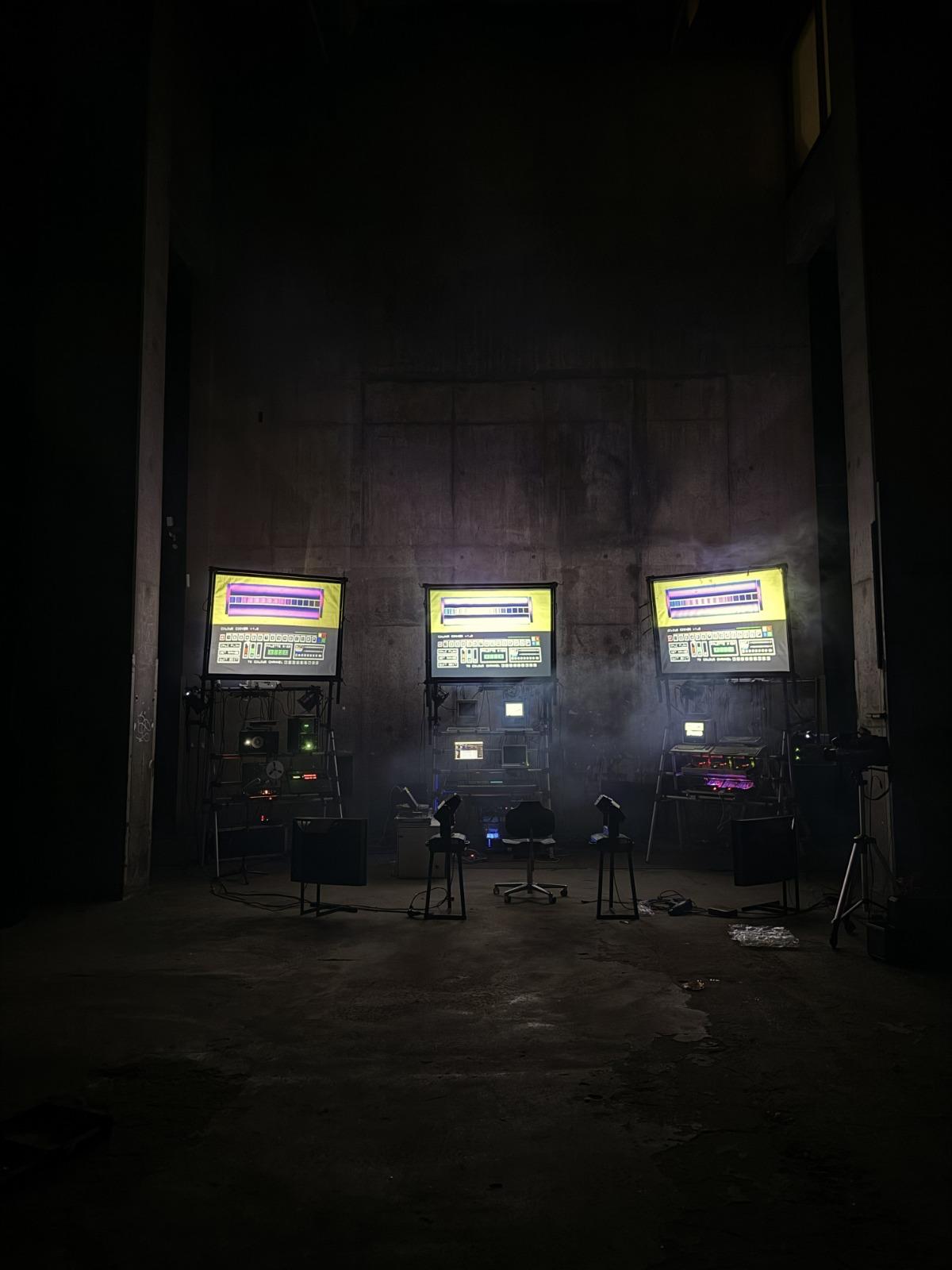
Work’s own account
The work describes itself as reflecting on machine creativity and the distance between two eras of artificial intelligence. Its question is what happens when a contemporary model learns the language of instruments built before it was conceivable. Those machines were built on the idea of the computer as a collaborator. After decades in storage, they are used again with language models that work inside the constraints their designers wrote. The agents and the performer hold partial control, and the logic of earlier machines shapes both. agency is redistributed through historical instruments.
Pandiello’s essay is read by the agents daily and translated into the instruments’ own protocols. It is expressed again in a language it was not written in, differently each time. Between those moments the system turns to its own creators, showing footage of the inventors of the digital revolution manipulated by Lucas Laujedo. During those moments the agents revise their own work using material they generated earlier.
No material in this practice comes from a model trained on finished music. Sound and image are built inside the machines one parameter at a time. Both parties work through the same vocabulary, so each can see what the other is doing. The performance runs for an hour.
The synopsis edited in July 2026 keeps three phrases of its own. It treats the machines as genuinely other, it describes them as submissive, and it speaks of the digital ghost that remains when the performer steps back. The work accumulates. Every session leaves states in a shared memory that later sessions take up, break apart and return altered. The lightweight protocols that carry it let creative intelligence run locally on consumer hardware, at less expense than generative sound or video models.
Legibility of the machines
Public discussion of artificial intelligence in the arts turns on whether a machine can be creative, or whether it will replace the artist. Both questions measure the machine against a human standard. Each machine has its own history, its own language and its own limits. The instruments are small enough to be understood completely, and every function is exposed. A person, an agent or both together can play the same instrument without adaptation. That is an arrangement of shared competence. What overloads a human operator also overloads an agent.
The system is designed around one mental model that both can keep. Most accounts of collaboration place the human at goal-setting and the machine at execution. David Behrman’s On the Other Ocean of 1977 followed two musicians and changed its harmonies in response to them. George Lewis’s Voyager, developed from the 1980s, improvises alongside human musicians while pursuing a behaviour of its own. Both descend from the man-computer symbiosis J.C.R. Licklider described in 1960.
The assumption underneath is older than any of them and visible in the equipment. The oscilloscope in the first tower was sold as a kit whose assembly manuals included a full theory of operation. The person using a device was expected to understand how it works.
Unforeseen
Here the unforeseen situations, sometimes difficult, sometimes unexpectedly interesting, will be described as the project runs. Many of these unforeseen situations have already occurred and have been recorded. They will be added in the time to come.